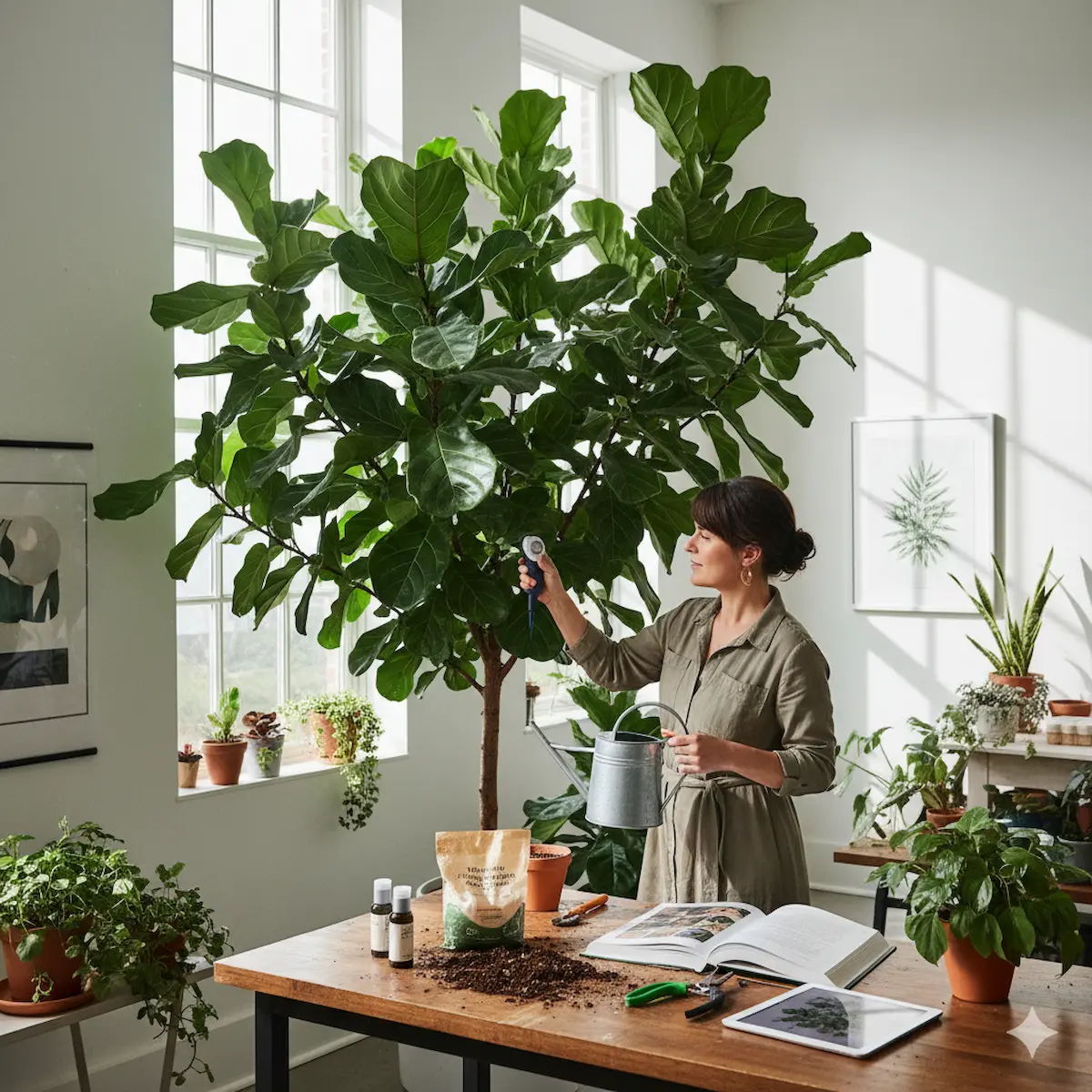
If you’re reading this, chances are one of two things is happening: either you landed a gorgeous new Fiddle Leaf Fig (Ficus lyrata), or your old plant is behaving sick and you want to right the ship. and now you want fiddle-leaf fig care
Fiddle Leaf Figs are famous… for dropping leaves, sporting brown spots, and being all-around persnickety.
But here’s the thing: they are not hard. They are just misunderstood.
The vast majority of the time, people are giving incorrect care information for fiddle-leaf figs. In this guide, we’ll answer all your questions and let you in on some secrets so you can transform from a worried plant parent to an expert.
The “Happy Plant” Essentials (Basic Care)
Before we even start troubleshooting any issues or difficulties, these four fundamentals are what your plant needs to be happy.
Light: The Facet of Success
This is the crucial part. Fiddle-leaf figs require plenty and plenty of bright, indirect light.
Best Spot: Near a window that gets some good light all day, but not so many direct sunbeams on the leaves. An east-facing window (morning sun) is ideal.
Do Not Do This: Don’t place it in full sun right next to a hot, south-facing or west-facing window—the sun will burn its leaves. And don’t shove them into dark, drab corners.
2. Such a perfect moistness and dryness!
This is the second most important. The vast majority of humans kill their fiddle-leaf figs with kindness, overwatering them into oblivion.
Watering: Check the moisture level with your finger 2-3 inches into the soil. If it feels bone dry underneath that depth, then water. If you feel even the slightest bit of moisture, wait another two or three days.
How to Water: Should you water? Give it plenty of water, enough that you see the water running out from the drainage holes at the base of the pot. Then let it dry out all the way to 2-3 inches deep before you water again.
Fiddle-leaf fig Humidity & Temperature care
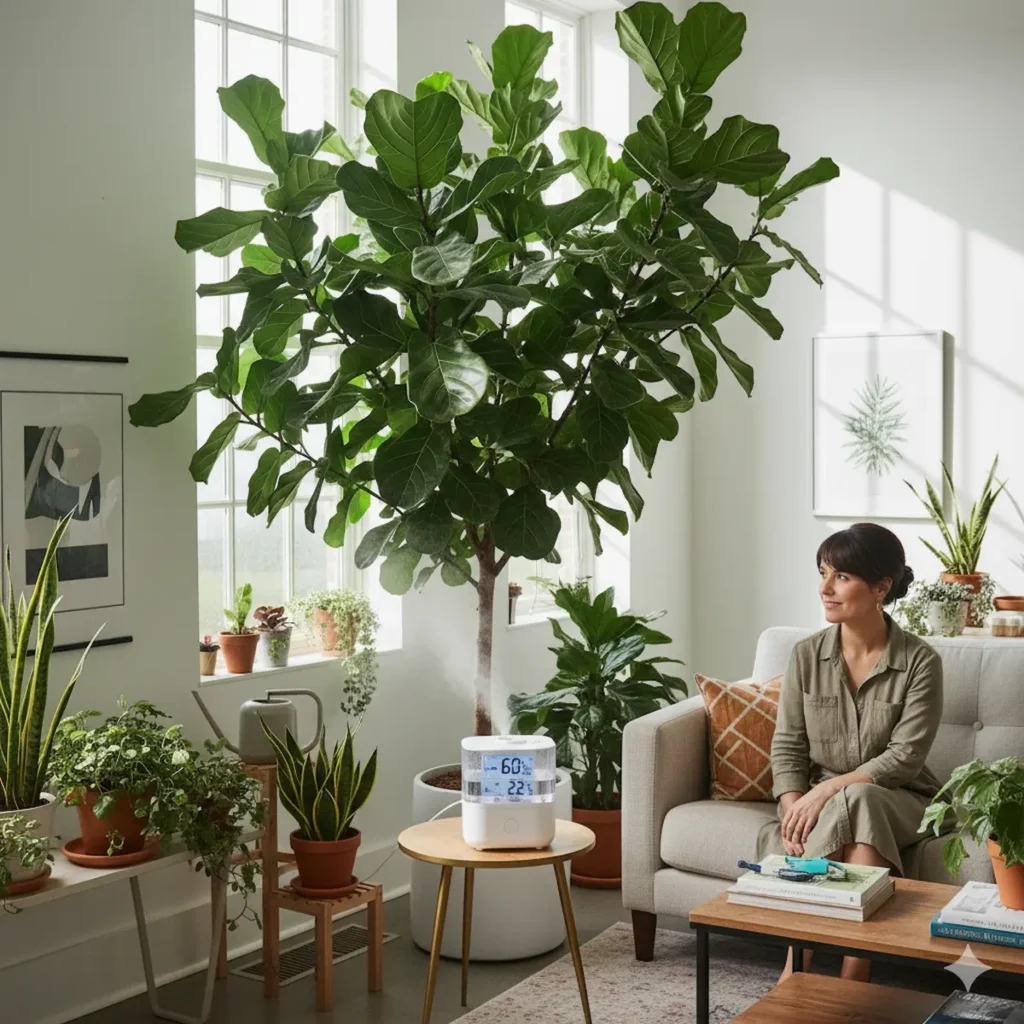
These are tropical plants, after all; they love humidity.
Do fiddle-leaf figs like to be misted? They certainly have no problem being misted 2 or 3 times a week, especially if the climate is very dry. You might also keep a humidifier close to where you’re singing.
Temperature: They prefer average room temperature (between 18° and 25°C). Get them out of the way of cold drafts from an AC or open window, as well as heaters.
Soil & Fertilizer
Soil: Use a good quality “well-draining” soil mix. There must be holes in the bottom of the pot.
Fertilization/Feeding: Feed approximately once a month with an all-purpose, liquid fertilizer in the growing season (spring and summer). That helps it develop big, healthy leaves.
Troubleshooting Common Problems (The “Drama” Area)
This is what most people are looking for.
Help! Why Are My Fiddle Leaf Fig Leaves Falling Off?
Leaf fall is their form of protest. The most common reasons are
Surprise: You just bought the plant. It is adapting to its new conditions.
Overwatering: the soil stayed wet (this is what most often happens).
Under-watering … You have forgotten to water it, and the soil is as dry as a bone.
Cold Draft: The factory is close to an AC vent or a cold, drafty window.
The Fix: First, check the soil. If it’s wet, stop watering. If it’s bone-dry, water well. Place it in a bright location and let it be. Don’t keep moving it.
Why Are My Fiddle Leaf Fig Leaves Turning Brown?
Brown spots actually come in two varieties:
Crispy, Dark Brown Spots (Sunburn)—As in, if you observe some dry, crispy brown spots at the center or on the edges of leaves, it’s sunburn caused by direct sunlight. Get the plant out of the window at once.
Soft, Dark Brown Spots (Root Rot) Soft dark brown or black spots that are spreading from the bottom of the leaf up are root rot. This is an overwatering problem, and it’s not good. Stop watering immediately. You might also have to repot the plant in fresh, dry soil.
What’s Wrong With My Fiddle Leaf Fig Leaves Turning Yellow?
As one or two of the oldest, bottom leaves turn yellow and drop off, that’s normal. But if multiple leaves are yellowing, it’s 99 percent a sign of too much water. The soil remains over-saturated.
Growth & Maintenance (Advanced Care)
How to Make a Fiddle Leaf Fig Bushy?
If your plant is simply getting tall and “leggy,” the way to make it bushy is by pruning.
- In spring, use a clean pair of shears to snip the top off the main stem.
- And as a result, the plant gets a signal to develop new branches from each of the nodes that are under the cutting. This is where that fuller, bushier vibe comes from.
When Do I Need to Repot a Fiddle Leaf Fig?
You typically need to repot it every 1-2 years. The signs are:
- Water just passes through the soil and out the bottom.
- You can see roots poking out of the drainage holes.
- The plant has stopped growing altogether. If repotting, opt for a new pot that is one to two inches larger than the old one.
How do I make fiddle-leaf figs grow taller?
oversaturated.Light: This is the 1 factor. The brighter the indirect light, the quicker it grows.
Fertilizer: Give it a feeding each month during the growing season.
Support: As the plant grows taller, you might want to provide it with a moss pole or stake to encourage straight upward growth.
Patience: They aren’t speed demons. Good growth might be 1-2 feet a year.
Do Fiddle Leaf Figs Fruit?
Fiddle-leaf figs grown indoors do not bear fruit. They have extremely specific pollination requirements that you wouldn’t be able to duplicate indoors.
What is the difference between a fiddle-leaf fig and a fig tree?
The Fiddle Leaf Fig (Ficus lyrata) is known for its huge, fiddle-shaped leaves. The common fig tree (Ficus carica) is cultivated for its small leaves and the fruit we love to eat.
Do fiddle-leaf figs like to be misted?
Yes, they do like humidity. When it comes to misting them, 2-3 times a week is great, especially if you live in a particularly dry house.
How often should I water my fiddle-leaf fig?
There is no set schedule. Water only when the top 2-3 inches of soil are dry. This may be once a week in summer or as infrequently as only every 2-3 weeks in the winter.