A ficus tree is the classic indoor tree for a reason: one plant can fill an empty corner with glossy green leaves for twenty years, asking for little more than bright light, careful watering, and being left alone. The most common indoor ficus tree is the weeping fig, Ficus benjamina, a tropical tree from Southeast Asia and Australia that grows into a graceful, arching canopy. It has a dramatic reputation, mostly because it drops leaves whenever something changes, but the care itself is simple once you understand what it wants.
So what is a ficus, exactly? It is not one plant but a whole genus of more than 850 species, ranging from tiny creeping vines to towering outdoor trees. A ficus plant can be a rubber tree, a fiddle leaf fig, a creeping fig, or the weeping fig in your living room. This guide covers ficus tree care for the indoor trees most people actually own, with the weeping fig leading the way.
What Is a Ficus Tree?
A ficus tree is any tree-form member of the Ficus genus grown as a houseplant or landscape tree. Indoors, the star is Ficus benjamina, the weeping fig, with small glossy leaves on thin arching branches. Outdoors in warm climates the same plant can reach 60 feet, but in a pot it usually tops out around 6 feet, which is exactly why it suits a living room.
The ficus types worth knowing are easy to tell apart once you see them side by side. The weeping fig (Ficus benjamina) has small, pointed, glossy leaves and a soft, drooping shape. The Audrey ficus (Ficus benghalensis ‘Audrey’) has broader, velvety leaves with pale veins and a sturdier trunk. The ficus rubber tree (Ficus elastica) carries big, stiff, dark green leaves and tolerates lower light better than its cousins.
The ficus bonsai tree, usually Ficus microcarpa or Ficus retusa, is the same genus trained small in a shallow pot. And the fiddle leaf fig (Ficus lyrata), with its huge violin-shaped leaves, is the dramatic sibling — our fiddle leaf fig care guide covers it in full, because it asks for brighter light and a stricter watering routine than the weeping fig. For the botanical background behind all of them — species count, native range, and mature size — Better Homes & Gardens has a clear ficus reference worth bookmarking.
Two ficus tree varieties often confuse new buyers. Ficus benjamina ‘Starlight’ has the same arching form with cream-edged leaves, and Ficus benjamina ‘Too Little’ is a compact, slower-growing form with small curled leaves. Both want the same care as the standard weeping fig. The creeping fig (Ficus pumila) is the odd one out: a small-leaf vine that climbs walls rather than growing into a tree.
Ficus Tree Care at a Glance
- Light: bright, indirect light; an east-facing window is ideal.
- Water: when the top 1 to 2 inches of soil feel dry, usually every 7 to 10 days in spring and summer.
- Humidity: 40 to 60 percent; average indoor air is usually enough with a little help in winter.
- Temperature: 65 to 80°F (18 to 27°C); never below 55°F.
- Soil: loose, fast-draining mix that still holds some moisture.
- Feeding: half-strength balanced liquid fertilizer, monthly in spring and summer only.
- Repotting: every 2 to 3 years, in spring.
Get those seven right and the plant mostly takes care of itself. The sections below explain each one, including the one mistake that kills more ficus trees than anything else.
Light: Bright, Indirect, and Steady
Light is the foundation of ficus tree care. A ficus tree wants the brightest indirect light you can give it — the kind of light you get a few feet back from a sunny window, strong enough to read by comfortably at noon without a sharp beam landing on the leaves. An east-facing window with gentle morning sun is perfect, and a few feet back from a south or west window works too.
Direct midday sun scorches the leaves, leaving pale, bleached patches and crispy brown edges that never heal. A dark corner keeps the plant alive but barely growing, with sparse leaves and long, leggy stems. My neighbor keeps her weeping fig by an east-facing window and says the only rule that matters is leaving it alone once it settles in. If your only windows face south or west, hang a sheer curtain or set the pot back two or three feet from the glass.
Low light is the most common reason a weeping fig slowly thins out indoors. If new growth is small and pale and the lower branches keep going bare, move the tree closer to the light gradually, over a week or two, rather than all at once.
Watering: How Much and How Often
How often to water a ficus is the question every new owner asks, and the honest answer is: when the top 1 to 2 inches of soil feel dry, not on a calendar. In most homes that means every 7 to 10 days in spring and summer, and every 10 to 14 days in winter, when growth slows and the soil stays damp longer. Pot size, light, and humidity all change the timing, so check the soil with your finger instead of following a fixed schedule.
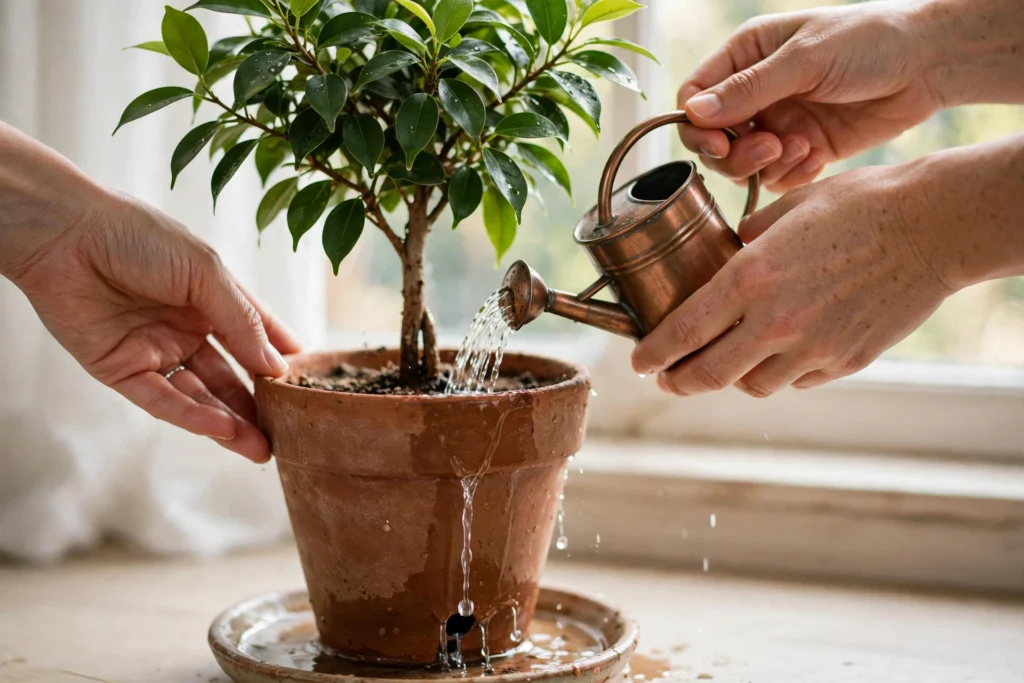
Water slowly and evenly around the edge of the pot until water runs freely from the drainage holes, then empty the saucer. The soil should feel like a wrung-out sponge — damp all the way through, never soggy. Roots sitting in standing water rot quickly, and overwatering is the number one killer of indoor ficus trees. The warning signs are yellowing lower leaves, soft stems at the base, and a sour smell from the soil. Underwatering is far easier to fix: the leaf edges turn crisp and brown, and the plant perks up within days of a good soak.
Use room-temperature water when you can, and never water on a schedule just because a week has passed — a ficus tree in a cool, dim room may need water half as often as the same plant in a bright, warm one.
Soil and Repotting
A ficus tree needs soil that drains fast but still holds a little moisture for its roots. Dense, heavy potting soil compacts around the roots and suffocates them, so do not plant it in plain garden soil or a peat-heavy mix straight from the bag. A reliable blend is 2 parts quality potting mix, 1 part perlite or orchid bark, and 1 part coco coir or peat moss. The bark creates air pockets, the perlite keeps drainage fast, and the coir holds the gentle moisture the roots want. Whatever mix you use, the pot must have drainage holes.
Repot only when the plant needs it, every 2 to 3 years or when roots circle the drainage holes. Choose a pot just 1 to 2 inches wider than the old one; too much fresh soil stays wet and invites rot. Spring is the best time, at the start of the growing season. Expect a short sulk after repotting — a few dropped leaves are normal while the roots settle, and the tree usually recovers within a few weeks.
Humidity and Temperature
Ficus trees come from warm, humid forests, so they like humidity between 40 and 60 percent. Average indoor air in summer is usually fine, but winter heating can drop it to 30 percent, and the first sign of trouble is brown, crispy leaf edges.
Grouping plants together, setting the pot on a tray of pebbles with water kept below the pot’s base, or running a small humidifier a few feet away all help. If you want another humidity lover for the same room, our bird’s nest fern care guide covers a plant that asks for even more moisture and forgives far more than a ficus does. Misting looks helpful but raises humidity for less than two minutes, so skip it as a strategy.
Temperature matters just as much. A ficus tree is happiest between 65 and 80°F, and it will tolerate down to about 55°F for a short time, but anything below that damages the leaves. Keep it away from cold drafts, drafty windows in winter, and air-conditioning vents blowing directly on it. Sudden temperature swings stress the plant more than a steady cool room does, which is why the golden rule of ficus care is stability: same spot, same rhythm, minimal fuss.
Feeding Your Ficus Tree
Ficus trees are light feeders. Feed only during the growing season, spring through early fall, with a balanced liquid houseplant fertilizer diluted to half the recommended strength, once a month at most. A standard 10-10-10 or 3-1-2 ratio suits them well. Never feed a dry plant — water thoroughly first, then follow with the diluted fertilizer.
Skip feeding entirely in fall and winter, and skip it for a stressed or recently repotted tree until you see new growth. If the leaf tips turn brown even though watering is right, overfeeding is the likely culprit: flush the pot with plain water and hold off feeding for a couple of months.
Pruning and Shaping a Ficus Tree
Learning how to prune a ficus tree is mostly about timing and restraint. Prune in late spring or early summer, when the tree is actively growing, and never in fall or winter, when it is resting. Use clean, sharp bypass pruners and cut just above a leaf node, where new branches will sprout. To make a leggy tree bushier, snip the top off the main stem in spring; the tree responds by branching from the nodes below the cut.
How to trim a ficus tree without stressing it comes down to how much you remove: never take more than a third of the foliage at once. Small, regular trims beat one drastic haircut. The same rule covers how to cut back a ficus tree that has outgrown its corner — work in stages over a few weeks if a big reduction is needed.
For a ficus benjamina tree specifically, prune for shape after the spring growth flush, and always step back to look at the whole shape before the next cut. Wear gloves if you have sensitive skin, because the milky sap can irritate, and wipe the blades with rubbing alcohol between cuts so you do not spread disease.
How to Propagate a Ficus Tree
Propagating a ficus tree is easier than its reputation suggests. The simplest method is a stem cutting: in spring, cut a 6-inch piece from a healthy stem just below a leaf node, remove the lower leaves, and set it in a jar of clean water on a bright windowsill. Roots usually appear in 3 to 5 weeks; change the water weekly so it stays oxygenated. Pot the cutting once roots reach 2 inches, using the soil mix above.
Air layering also works on mature trees and is the better choice for a thick branch. Choose a point about 18 inches from a shoot tip, remove a ring of bark, wrap the wound in moist sphagnum moss and plastic wrap, and wait a month or two until roots show through the moss. Then cut below the rooted section and pot it.
Leaf Drop: Why It Happens and How to Fix It
A ficus tree dropping leaves is almost always reacting to change, not dying. It sheds leaves when it is moved, repotted, rotated, or hit by a draft or a sudden drop in light — a survival habit from forests where shedding leaves conserves resources until conditions stabilize. A few leaves after any change is normal protest. Ongoing dropping with soft, dark spots points back to overwatering, while crispy leaf edges point to low humidity or underwatering.
The fix is usually to do less, not more. Check the soil first: if it is wet, stop watering; if it is bone-dry, water well. Put the tree in a bright spot and leave it there for at least two weeks before changing anything else. New leaves usually emerge within 3 to 6 weeks once conditions steady.
Common Problems: Pests, Yellow and Brown Leaves
Most ficus tree problems trace back to water, light, or humidity, and the pattern tells you the cause. Yellow leaves on the lower branches usually mean overwatering. Brown, crispy edges mean low humidity or underwatering. Pale, bleached patches after a move are sunburn — the tree went into direct light too fast. Dark brown or black spots spreading from the base of a leaf mean root rot or leaf spot disease; remove the affected leaves and let the soil dry.
Pests are uncommon but watch for scale insects (small brown bumps on stems and leaves), mealybugs (white cottony clusters), spider mites (fine webbing and speckled leaves), and whiteflies. Wipe scale and mealybugs off with a cloth dipped in rubbing alcohol, rinse spider mites off with a strong spray of water, and check weekly until they are gone. Good air circulation and correct watering keep all of them rare.
Indoor or Outdoor: Where a Ficus Tree Belongs
An outdoor ficus tree thrives year-round only in USDA Zones 10 to 11, where winters stay warm. In cooler zones, grow it in a container that can move indoors when frost nears, or keep it as a houseplant all year. Outdoor trees grow fast — expect new growth within weeks of planting in spring — and their roots can disrupt nearby concrete, plumbing, and pools, so give them plenty of space and plant them away from structures.
Indoors, a ficus tree is a long-term resident, not a seasonal plant. A weeping fig in a bright room can live 20 years or more, and outdoor specimens in warm climates can live past 100. That longevity is the real payoff for the early patience: the first year is about settling in, and every year after that the tree only gets more impressive.
Pets and Safety: Ficus Trees and Cats
Ficus trees are mildly toxic to pets. The milky sap contains compounds that irritate the mouth and stomach, so a cat that chews the leaves may drool, vomit, or go off its food for a day. Serious poisoning is rare, but the plant is not a safe choice for a home where a cat treats every leaf as a snack. Keep the tree out of easy reach, offer cat grass as a safer alternative, and call your vet if your cat eats a large amount.
If you want the same tall, leafy look without the worry, our spider plant care guide covers a completely non-toxic plant that thrives in the same bright, indirect light and forgives missed waterings too. For a taller statement plant that is also safer around pets, the bird’s nest fern is another good roommate for the same window.
Size and Lifespan: How Big Does a Ficus Tree Get?
How big a ficus tree gets depends on the variety and where it grows. In a container indoors, a Ficus benjamina usually reaches about 6 feet, kept smaller by the pot. Outdoors in a warm climate, the same tree can top 60 feet with a broad canopy, and a ficus bonsai tree stays under 2 feet because it is pruned and root-trimmed every year, not because the species is small. With steady care, a houseplant ficus can live 20 years or more, and outdoor trees in warm climates can live well past a century.
Final Thoughts
A ficus tree earns its place honestly: it is sculptural, long-lived, and genuinely low-maintenance once you learn its two rules — bright, steady light and water only when the soil says so. Keep the spot stable, keep the soil from staying soggy, and it will reward you with a canopy that only gets more beautiful every year.
If you want a bolder statement plant for the same bright corner, our split leaf philodendron guide covers a fast-growing tropical with huge, split leaves that pairs beautifully with a weeping fig. Start with the ficus, and the rest of the collection follows naturally.
Why is my ficus tree dropping leaves?
A ficus tree drops leaves in response to change: a move, a draft, a repot, or a sudden drop in light. It is a survival habit, not a sign of death. A few leaves after any change is normal. Check the soil, hold the routine steady for two weeks, and new leaves usually emerge within 3 to 6 weeks.
How often should I water my ficus tree?
Water every 7 to 10 days in spring and summer, and every 10 to 14 days in winter, but only when the top 1 to 2 inches of soil feel dry. Soak the pot until water runs from the drainage holes, then empty the saucer so the roots never sit in standing water.
Are ficus trees toxic to cats?
Yes, ficus trees are mildly toxic to cats. The milky sap irritates the mouth and stomach, so a cat that chews the leaves may drool or vomit. Serious poisoning is rare, but keep the tree out of easy reach and offer cat grass as a safer alternative.