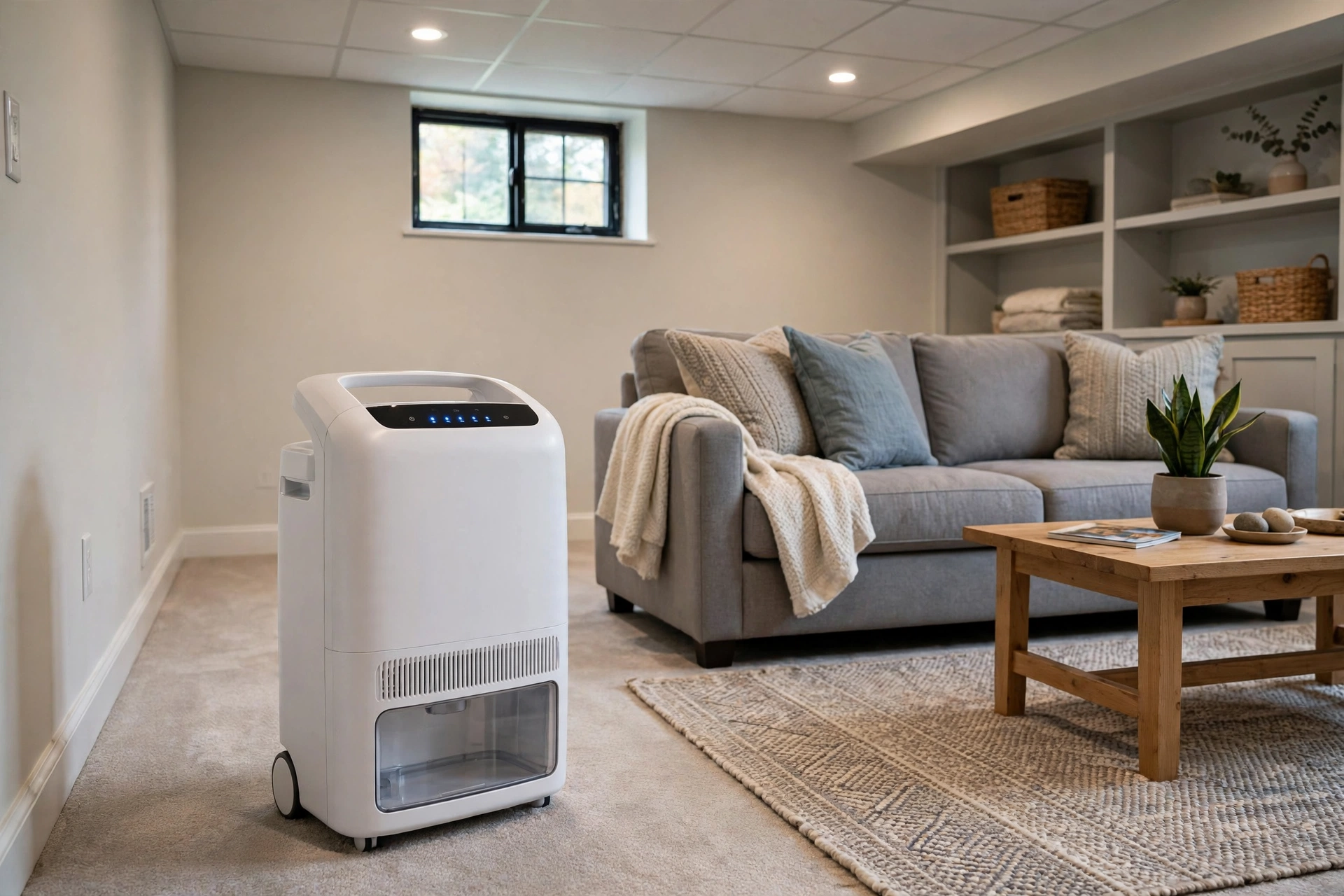
What Is a Whole House Dehumidifier?
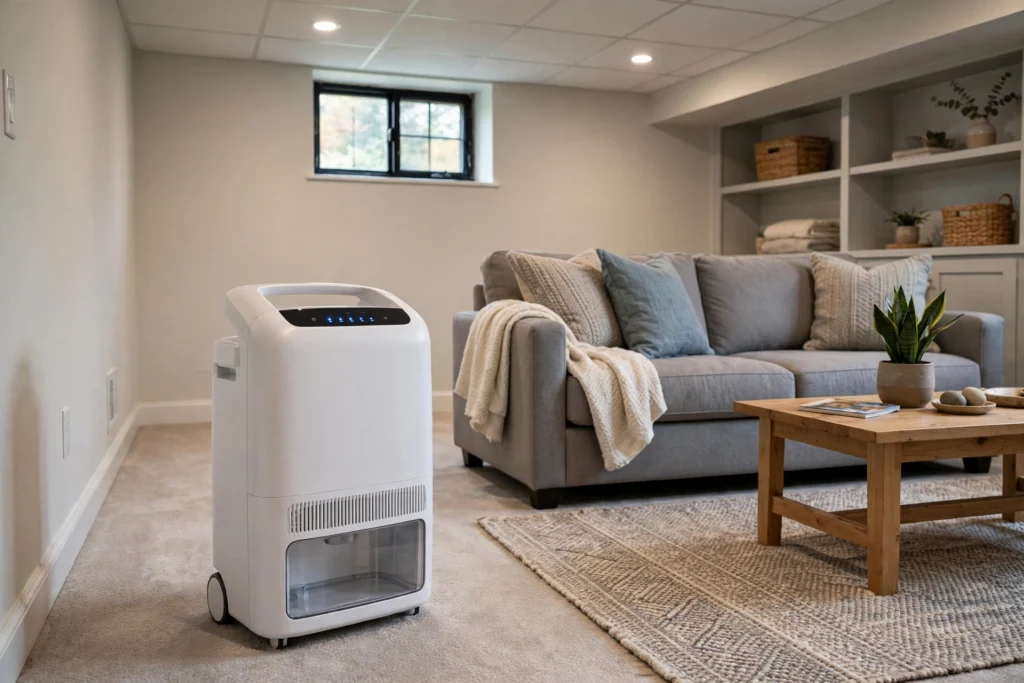
A whole house dehumidifier is a single, permanently installed unit that removes excess moisture from the air in every room of your home, not just one damp corner. Unlike a portable unit that you wheel from room to room and empty by hand, a whole home dehumidifier usually connects to your ductwork or sits in a basement, crawl space, or utility room and drains automatically. A humidistat tells it when to run, so your home stays near the humidity level you choose, day and night, without you thinking about it.
Most homes feel best when indoor relative humidity sits between 30% and 50%. The U.S. Environmental Protection Agency advises keeping it below 60%, ideally between 30% and 50%, because damp air gives mold what it needs to grow. When humidity stays high for weeks, you may notice musty smells, condensation on windows, and warped wood floors.
How Does a Whole House Dehumidifier Work?
So, how does a whole house dehumidifier work? Warm, humid air is pulled into the unit through your ducts or its own intake, then passes over cold coils. Moisture condenses on those coils, just like water beads on a cold glass in summer, and drips into a drain line. The drier air is reheated slightly and sent back into your home.
Because the unit is connected to a permanent drain, there is no bucket to empty: a floor drain, a condensate pump, or a drain line carries the water away. The humidistat keeps checking the air, so the unit cycles on only when humidity rises above your setting. That is the main difference from a portable unit: the whole-house unit treats the entire home automatically, instead of drying one room while the rest stays damp.
Whole House vs. Portable Dehumidifier: Which One Fits Your Home?
A portable dehumidifier is cheaper, easier to buy, and fine for one damp bedroom or a small basement, typically removing 20 to 50 pints of water per day. A whole house dehumidifier, by contrast, usually removes 70 to 130 pints per day and serves 1,500 to 6,000 square feet, depending on the model and your home’s moisture load.
Choose a portable unit if only one room feels damp, if you rent, or if your budget is tight right now. Choose a whole-house system if several rooms feel sticky, if musty smells return every summer, or if you are already emptying portable units daily. A neighbor of mine ran two portable units all summer and still had foggy windows every morning, until a single ducted unit finally kept the whole house steady. Homes without ducts can use a freestanding whole-home unit with a dedicated return grille.
Signs Your Home Needs a Whole House Dehumidifier
You may not need a hygrometer to guess, but a cheap one confirms it fast: if indoor humidity regularly reads above 55% to 60%, your home is a candidate. Watch for condensation on windows that returns even after wiping, a musty smell that air freshener never fixes, and damp-feeling bedding. Doors that stick in summer and cupped floorboards also point to moisture.
Allergy-type symptoms that get worse indoors can also be a clue, since dust mites thrive in humid air. When the signs show up in several rooms at once, the moisture problem is house-wide.
What Size Whole House Dehumidifier Do You Need?
Size is measured in pints of water removed per day, and square footage alone does not decide it: climate, air leakage, basement conditions, and household size all change the moisture load. As a rough guide, a 1,500-square-foot home often needs 50 to 70 pints per day, a 2,000-square-foot home 70 to 90 pints, and a home over 3,000 square feet usually 90 pints or more.
Manufacturer sizing guides are a better check than square footage alone, because they factor in your target humidity: holding a home at 40% takes noticeably more capacity than holding it at 50%. An HVAC contractor can run a proper load check, and that step is worth it, since an undersized unit runs nonstop and still leaves rooms damp. If you are comparing models, check the pint rating at standard test conditions, since ratings measured at different temperatures are not directly comparable.
Whole House Dehumidifier Installation: What to Expect
Whole house dehumidifier installation is usually a professional job, and most installs take a few hours to a full day. The unit is mounted in a basement, crawl space, attic, or utility closet, then connected to your ductwork or fitted with its own supply and return. The installer runs a drain line to a floor drain or adds a condensate pump if no drain is nearby, wires the unit to a dedicated circuit where required, and mounts the humidistat control in your living space.
Costs rise when ductwork must be added, when access is tight, or when electrical work is needed. A straightforward ducted install with a nearby drain sits at the lower end of the range, while custom ducting, a pump, and difficult crawl-space access push it higher. Before work starts, ask the installer to confirm the drain route and the filter location, so the unit stays easy to reach for upkeep.
How Much Does a Whole House Dehumidifier Cost?
For most U.S. homes, a whole-house system costs roughly $1,500 to $3,500 installed, including the unit and labor. The equipment alone commonly runs $900 to $2,000, with the rest paying for sizing, delivery, duct connections, wiring, drainage, and testing. Smaller 70 to 80-pint units usually land near the lower end of the installed range, while 120-pint and larger systems for big homes land near the top. Prices vary by region and by how much ductwork your home needs.
Running costs are modest by comparison. Energy Star models in current listings use roughly 600 to 900 kWh per year, or roughly $15 to $35 a month in electricity for many households, depending on local rates and climate. Get two or three written quotes, and make sure each one lists the same capacity, so you are comparing like with like.
Do Whole House Dehumidifiers Work With Air Conditioning?
Yes, and they complement it. Air conditioning cools air and removes some moisture as a side effect, but on mild, humid days your air conditioner may not run long enough to dry the air properly. That is when a home can feel cool yet clammy. A whole house dehumidifier dries the air without needing to overcool it, so it keeps working even when the air conditioner cycles off. If you are weighing a dehumidifier for air conditioning support, this is the key benefit: comfort comes from humidity control, not just temperature.
In practice, the two systems share ductwork, and the dehumidifier runs only when humidity rises above your setting. Some homeowners find they can set the thermostat a degree or two higher once humidity is under control, because dry air feels cooler. In winter, most whole-house units run far less, since cold outdoor air is naturally drier once heated indoors.
Running Costs and Simple Upkeep
A whole-house unit asks little of you, but the little it asks matters. Change or clean the filter on the schedule in the manual, usually every few months in heavy-use seasons, since a clogged filter cuts airflow and forces the unit to work harder. Check the drain line once a year for clogs or kinks, and make sure a condensate pump, if you have one, still runs freely. Keep the area around the unit clear so air can move and a technician can reach it.
If the unit stops draining, humidity climbs again fast, so a puddle near the unit or a sudden return of musty smells is worth checking right away. For deeper upkeep, such as coil cleaning, follow the manufacturer’s guide or ask your HVAC technician during a routine visit. How to maintain a dehumidifier for basement use
Frequently Asked Questions
Do whole house dehumidifiers work?
Yes, when sized correctly for the home. Do whole house dehumidifiers work in every home? They work best in homes with a genuine house-wide moisture problem, ductwork or a suitable spot for a freestanding unit, and a drain nearby. They will not fix an active leak or flooding on their own, so fix water entry first, then let the unit control everyday humidity.
How much does a whole house dehumidifier cost to run?
Most households spend roughly $15 to $35 a month on electricity for a whole-house unit in humid months, with lower costs in dry seasons. Energy Star models use less power per pint of water removed, so the efficiency rating matters more than the sticker price over the unit’s life.
What humidity should I set it to?
Aim for 45% to 50% in summer for comfort and mold prevention; the EPA’s ideal range is 30% to 50%, and staying below 60% is the key ceiling. Setting the unit below 40% in summer wastes energy without adding comfort.
Is a whole house dehumidifier worth it?
It is worth it if humidity is high across several rooms, if portable units cannot keep up, or if moisture is damaging wood, paint, or stored belongings. For a single damp room, a portable unit is the smarter buy. For a whole damp house, one ducted system usually beats running several portables.
Final Thoughts
A whole house dehumidifier is not for every home, but for a humid house it changes daily comfort in a way a portable unit cannot match: it dries every room at once, drains itself, and holds humidity steady without daily attention. Size it by moisture load, not square footage alone, and fix any active leaks before installation day.
If your dampness is concentrated in the basement, start with our guide to choosing the right unit for that space: Choose the right dehumidifier for your basement. If basement moisture and musty smells are your main problem, see how to tackle them here: Dehumidifier for basement moisture control. And if damp rooms are attracting silverfish, a drier whole house helps there too: Dehumidifier for silverfish. For the EPA’s own mold and moisture guidance, see U.S. EPA, A Brief Guide to Mold, Moisture and Your Home.