Bird of paradise plant care is simpler than the plant’s dramatic looks suggest. The bird of paradise plant (Strelitzia reginae) is famous for its huge, banana-like leaves and orange-and-blue flowers that look like a tropical bird taking flight. It looks like a plant that needs a greenhouse, but it can thrive in an ordinary living room with strong light, a watering rhythm that follows the soil, and a pot that drains.
Native to the coastal grasslands of South Africa, it evolved under full sun and seasons of heavy rain followed by drier spells — which explains almost everything about caring for bird of paradise at home: a sun lover first, a tropical plant second, it forgives a missed watering far more easily than a dark corner or soggy soil. This guide covers light, watering, the best soil for bird of paradise, feeding, temperature and humidity, and the honest truth about getting a bird of paradise flower indoors — plus the one thing most guides skip: it is mildly toxic to cats and dogs.
Know Which Bird of Paradise You Own
Most bird of paradise plants sold are one of two species. Strelitzia reginae, the common or orange bird of paradise, stays compact at 3 to 5 feet indoors and bears the famous orange-and-blue flowers. Strelitzia nicolai, the giant bird of paradise or white bird of paradise, grows into a tree-like plant with huge paddle leaves — outdoors it can reach 20 to 30 feet. If your plant’s leaves keep getting bigger with no flowers in sight, you may have a giant on your hands.
Do not confuse it with the Mexican bird of paradise, desert bird of paradise, red bird of paradise, or yellow bird of paradise sold at garden centers — those are Caesalpinia shrubs for hot, dry outdoor climates, with completely different care.
Light: The Make-or-Break Factor
Light is the single most important part of bird of paradise plant care, and where most owners go wrong. This is a sun plant: indoors it needs the brightest spot in your home — right beside a south- or west-facing window, with 4 to 6 hours of direct sun a day plus bright light the rest of the day. An east window with strong morning sun is the next best choice.
How much light does a bird of paradise need indoors? As much as you can possibly give it. In medium light it survives but grows slowly, stretches toward the window, and makes smaller leaves; in a dim room it stops growing and will almost never flower. If your plant sits more than 3 or 4 feet from a bright window, a full-spectrum grow light running 10 to 14 hours a day in winter makes a real difference. Ease it into direct sun over 7 to 10 days, and rotate the pot every two weeks so it grows evenly.
Watering: Soak, Drain, Then Wait
Bird of paradise watering follows one rule: water thoroughly, let it drain completely, then wait until the soil dries before watering again. How often to water bird of paradise depends on light and season, not on the calendar — usually every 7 to 10 days in a bright spot in summer, and every 2 to 3 weeks in winter or lower light. Check with your finger first: push it about 2 inches into the soil, and water only if it feels dry at that depth.
When you do water, soak the pot slowly until water runs freely from the drainage holes, then empty the saucer within 15 minutes. Overwatering kills more bird of paradise plants than anything else — the plant stores water in thick, fleshy roots, so it copes with a missed watering far better than with wet soil. When in doubt, wait another day.
Best Soil for Bird of Paradise
The best soil for bird of paradise is a rich, loose mix that holds some moisture but drains fast. Dense, heavy potting soil packs down around the roots, stays wet, and suffocates them — so never use plain garden soil or a peat-heavy mix straight from the bag. A reliable blend is 2 parts quality potting mix, 1 part perlite or orchid bark, and 1 part coco coir, slightly acidic at around pH 5.5 to 6.5. Always use a pot with drainage holes.
Repot every 2 to 3 years in early spring, or when roots circle the drainage holes. Choose a pot just 1 to 2 inches wider than the old one and a heavy one, because a tall bird of paradise in a light plastic pot tips over easily. Never repot in fall or winter, when the plant is barely growing.
Temperature and Humidity
The bird of paradise likes the same temperatures you do: 65 to 85°F (18 to 29°C) during the day, a little cooler at night. It tolerates down to about 50°F, but anything colder damages the leaves, so keep it away from cold drafts and air-conditioning vents. Hardy outdoors only in USDA zones 10 to 12, in most of the United States it is a bird of paradise indoor plant that can spend summer on a sunny patio.
Humidity is less demanding than most tropical plants ask for: a bird of paradise houseplant is happy at 40 to 60 percent, close to average indoor air, and 50 to 70 percent is even better. My neighbor keeps hers next to a humidifier in winter, and her plant is the one in the building with leaves that never split or brown at the edges. Dry air below 40 percent browns leaf edges and splits new leaves as they unfurl, so a pebble tray or a small humidifier nearby helps in winter. Misting raises humidity for less than two minutes — skip it.
Feeding: Less Is More
Bird of paradise fertilizer is a spring-and-summer-only job: feed once a month from spring through early fall with a balanced liquid houseplant fertilizer diluted to half strength. High-nitrogen fertilizer pushes leaves at the expense of flowers, so do not overdo it. Never feed a dry plant — water thoroughly first. Stop feeding entirely in fall and winter, and skip it for a stressed or recently repotted plant until you see new growth.
The Bird of Paradise Flower: Getting It to Bloom
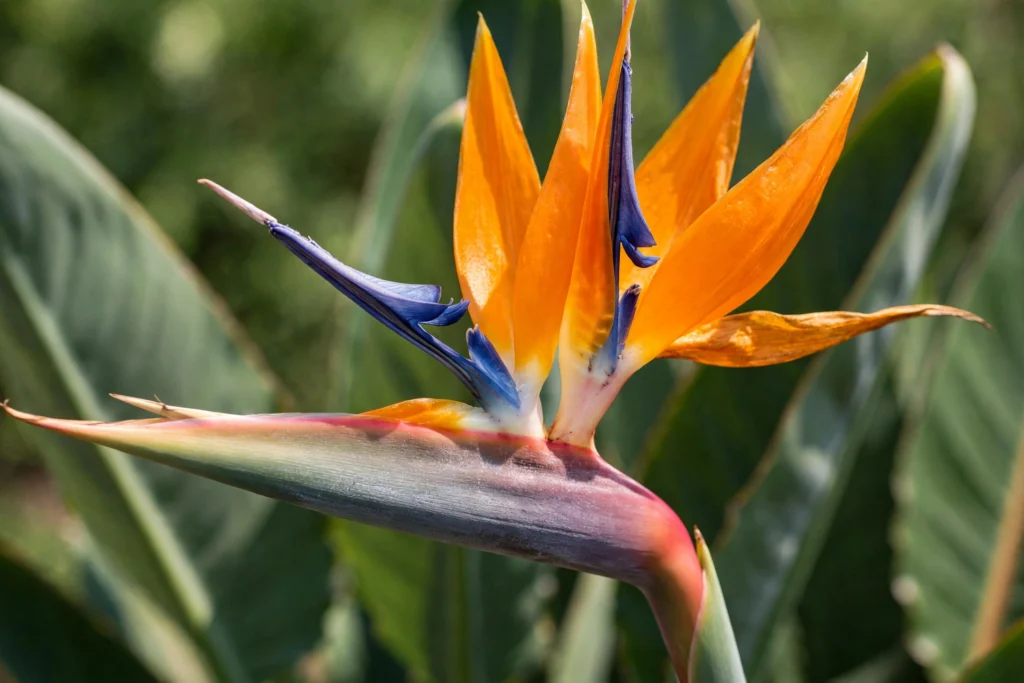
The bird of paradise flower is the reason most people buy this plant, and the part that tests patience. A bird of paradise plant indoor rarely blooms before it is 3 to 5 years old, and only a mature plant with strong light has a real chance. The flowers emerge one at a time from a green, boat-shaped spathe — three brilliant orange sepals and three bright blue petals that look exactly like a bird’s head in flight.
How to care for a bird of paradise flower starts with the same rules as the rest of the plant: as much direct sun as possible, a slightly snug pot, and no repotting every year. Let it dry out a bit more in winter, then resume regular watering and feeding in spring. Be honest about which type you own: the white bird of paradise almost never flowers indoors, while the orange bird of paradise is the one with a realistic shot — and even then it needs 6 or more hours of strong light a day.
Propagation by Division
Bird of paradise cannot be grown from leaf or stem cuttings — propagation is by division only. When you repot a mature plant in spring, separate natural divisions — clumps with their own roots and at least one or two leaves — and pot each one separately. Keep new divisions warm, bright, and lightly moist until they settle in.
Common Problems: Brown Leaves, Split Leaves and Pests
Most bird of paradise problems trace back to light, water, or humidity. Yellow leaves starting at the base usually mean overwatering — let the soil dry out and check that the pot drains. Brown, crispy leaf edges mean low humidity or underwatering — raise the humidity first, then check the watering rhythm. Some leaf splitting is normal — wind tears the leaves outdoors — but lots of splitting plus brown edges points to dry air. Watch for scale insects, mealybugs, and spider mites: wipe the first two off with rubbing alcohol on a cloth, and rinse mites off with a strong spray of water. For the botanical reference behind this guide, see the NC State Extension profile of Strelitzia reginae.
Bird of Paradise and Pets: The Honest Answer
No — and this is the honest part. Unlike our spider plant care guide and our bird’s nest fern guide, which both cover pet-safe plants, the bird of paradise is mildly toxic to cats and dogs: eating the leaves, flowers, or seeds can cause nausea, vomiting, and drowsiness. It is rarely life-threatening, but it is a real reason to keep the plant out of reach of curious pets and small children — keep it in a room the cat cannot reach, or choose one of the pet-safe plants in our other care guides instead.
Final Thoughts
Bird of paradise plant care comes down to three things: the brightest spot you have, water only when the top 2 inches of soil are dry, and patience about flowers. If you are building a tropical corner, pair it with our bird’s nest fern guide for a humidity lover that thrives in the same warm room, and our peace lily care guide for a flowering plant that asks for far less light. For a taller statement plant that loves the same bright window, our fiddle leaf fig care guide covers a tree with a stricter watering routine but the same love of sun.