There’s a reason some Christmas trees look like they belong in a magazine and others just look… fine. It’s rarely the budget. It’s the order you decorate in and a handful of small techniques — where the ribbon goes, how deep the ornaments sit, how many lights are actually on the tree. Get those right, and even a ten-year-old artificial tree can look brand new.
This guide gives you both sides: the professional decorating sequence, step by step, plus 21 ideas covering 2026’s biggest color trends, themes, and pro tricks. Whether you’re starting from scratch or refreshing the same ornaments you’ve had for years, there’s something here for your tree.
If you love decorating for every season, our fall home decor ideas and Halloween decorations 2026 guide will carry your festive style from autumn right into Christmas.
How to Decorate a Christmas Tree Like a Pro (the Exact Order)
Professionals always decorate in the same sequence, and the order matters — each layer builds on the last:
- Fluff every branch (artificial trees). Pull each branch tip outward and slightly upward, working from the bottom up. This single step makes the biggest difference on older trees.
- Lights first. Weave strands deep into the branches, working from the top down. Push some lights 6–8 inches inside the tree — depth is what makes a tree glow instead of looking strung.
- Ribbon or garland next, before ornaments get in the way (see the vertical cascade technique below).
- Ornaments, large to small. Biggest ornaments tucked deep inside, medium ones mid-branch, small and special ones at eye level and on branch tips.
- Picks and sprays to fill bare spots.
- Tree topper.
- Tree skirt or collar last — it hides the stand and anchors the whole look.
2026 Christmas Tree Color Trends
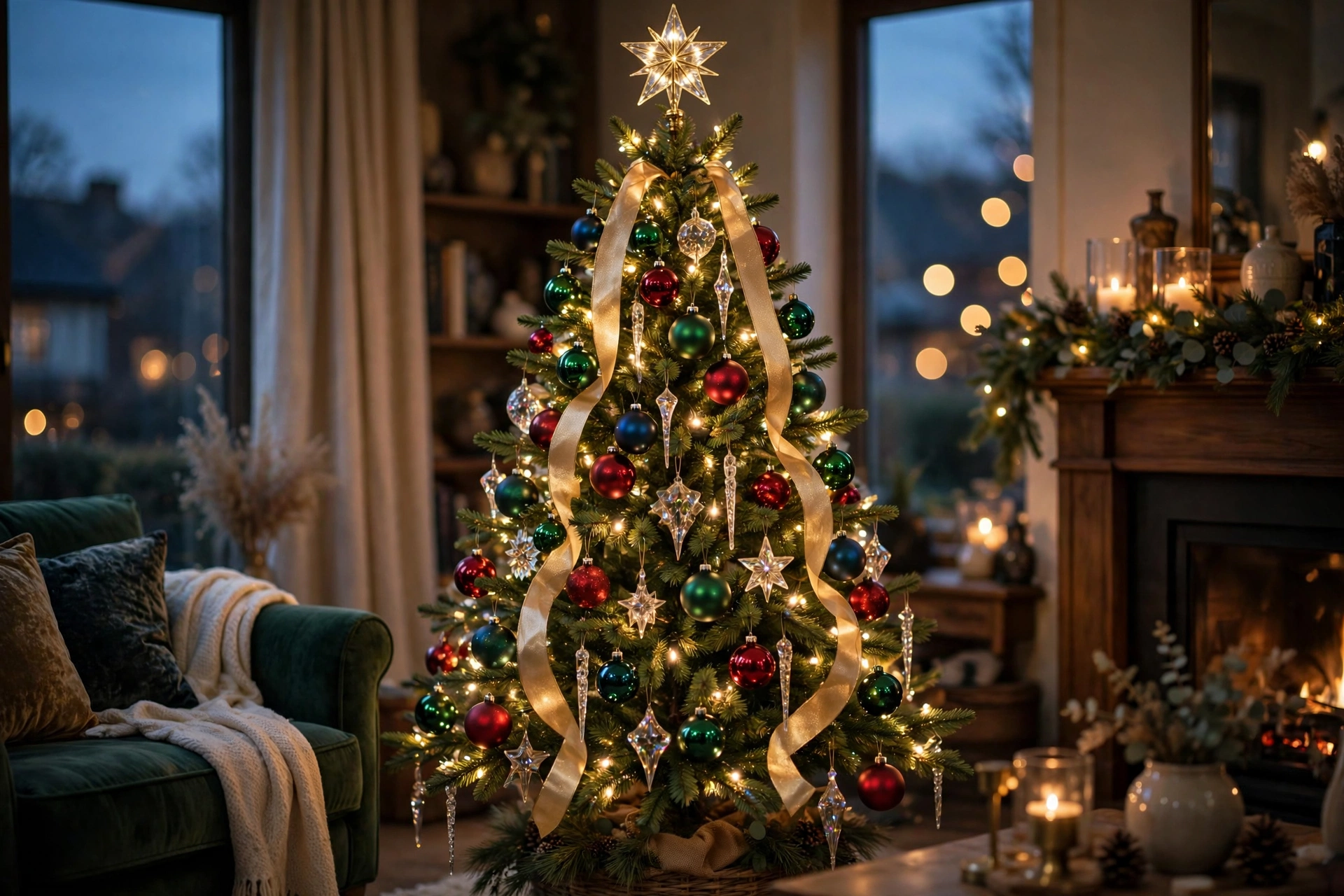
Idea 1: Jewel tones. Emerald, ruby, sapphire, burgundy, and plum are the defining 2026 palette — rich, saturated color that looks especially good on green trees with warm white lights. Commit fully: a jewel-tone tree with mixed metals looks intentional; a few jewel ornaments scattered among pastels looks accidental.
Idea 2: Cherry cola. Deep red-brown with a glossy finish is a 2026 breakout — vintage and modern at the same time. Pair it with gold ribbon and cream ornaments to keep it from going too dark.
Idea 3: Pastels. Blush pink, powder blue, and soft mint are still going strong for a dreamy, romantic tree. Pastels work best on white or flocked trees; on a green tree they can look washed out.
Idea 4: Champagne gold and metallics. Gold, champagne, copper, and silver mixed together — the luxe neutral that works with almost any theme and photographs beautifully.
Theme Ideas That Are Big for 2026
Idea 5: Glam luxe. Champagne gold ornaments, warm white lights, crystal or glass accents, and velvet ribbon. The rule: keep every element in the same metallic family so it reads as luxe, not busy.
Idea 6: Nostalgic storybook / Nutcracker. Vintage-style glass ornaments, deep reds, toy soldiers, and wooden nutcrackers arranged around the base. Nostalgia is the biggest 2026 decorating wave, and the tree is where it shines.
Idea 7: Alpine woods. Greens, browns, and creams with pinecones, wooden ornaments, burlap or faux-fur ribbon, and woodland animal ornaments. Rustic without tipping into country kitsch — keep the palette tight.
Idea 8: Scandinavian minimal. A sparser tree (or one with widely spaced branches), white and light-wood ornaments, simple paper stars, warm white lights only. The discipline is the design — resist adding “just one more thing.”
Idea 9: Candy cane classic. Red and white stripes, peppermint ornaments, red ribbon, white lights. Timeless, cheerful, and one of the easiest themes to shop because everything matches.
Idea 10: The personal tree. Travel ornaments, hobby ornaments, handmade ones from the kids. Fandom trees — sports teams, movies, bands — are a genuine 2026 trend. A tree that tells your story beats a perfectly coordinated one for pure joy, every time. Coordinate your mantel with your tree theme — see our Christmas mantel decor ideas — so the whole room feels designed as one.
Lighting: How Many Lights You Actually Need
Idea 11: Use the 100-per-foot rule. Plan on roughly 100 lights per foot of tree height — about 700 for a standard 7-foot tree, 900 for a 9-footer. If your tree has looked dim every year, you’re almost certainly under-lighting it.
Warm white vs. multicolor: warm white photographs better and suits most 2026 palettes; multicolor is the nostalgic pick. Either way, plug in and test every strand before it goes on the tree — replacing a dead strand mid-decorating is miserable.
Ribbon Like a Designer
Idea 12: The vertical cascade. Cut wired ribbon (2.5 inches wide works best) into 3–4 foot sections. Tuck the top of each section deep into the branches near the top of the tree, let it fall naturally, then tuck it in again lower down — creating a waterfall effect down the tree. Plan on about 20 yards of ribbon for a 7-foot tree.
Why vertical beats horizontal: wrapping ribbon horizontally around the tree makes it look stiff and banded — the number-one reason homemade trees look “crafty.” Vertical sections move naturally and show off the ribbon’s pattern instead of fighting it.
Ornament Placement That Looks Professional
Idea 13: Large ornaments go deep. Hang your biggest ornaments 4–6 inches inside the branch tips, not dangling off the ends. This creates depth and makes the tree look twice as full with the same ornaments.
I used to hang ornaments randomly until the tree looked “done” — switching to the large-to-small rule cut my decorating time nearly in half, and the tree looked fuller with the same box of ornaments.
Idea 14: Make ornament clusters. Tie three ornaments of different sizes together with a short piece of floral wire or a pipe cleaner, then hang the cluster as one unit. It’s an instant designer trick for sparse spots, and it keeps matched ornaments visually together.
Place your most special ornaments at eye level — about 5 to 5.5 feet up on a 7-foot tree — where they’ll actually be seen and appreciated.
Picks, Sprays & Fillers for a Fuller Tree
Idea 15: Fill gaps with picks. Berry sprays, glittered branches, eucalyptus sprigs, or feather picks pushed into bare spots add fullness for a few dollars each. Stick to one or two pick styles per tree so it looks intentional rather than random. This is also the cheapest way to refresh a tired artificial tree without buying new ornaments. Picks are one of the cheapest upgrades — see our budget Christmas decor ideas for more under-$25 refreshes.
Tree Toppers and Skirts That Finish the Look
Idea 16: Choose a topper with presence. Stars, angels, oversized bows, or a spray of picks and ribbon — whatever you choose, make sure it’s visible from across the room. A tiny topper on a big tree is the most common finishing mistake, and it’s a shame to nail everything else and fizzle at the top.
Idea 17: Don’t skip the base. A tree skirt, woven collar, or even a large basket hides the stand and grounds the whole tree visually. Match it to your theme — burlap or a basket for rustic, velvet for glam, a simple linen skirt for minimal.
Small-Space Trees and Alternatives
Idea 18: Go slim, pencil, or tabletop. Slim and pencil trees give you full height in a 2–3 foot footprint — ideal for apartments. A 3–4 foot tabletop tree on a console or side table can be just as festive as a full-size one. Wall-mounted half trees sit flat against the wall and need zero floor space. Small tree, same techniques: the order, the lights math (scaled down), and the ribbon cascade all still apply.
Real vs. Artificial: Timing Tips
Idea 19: Time it right. In the US, most families put the tree up the weekend after Thanksgiving — it’s the unofficial start of decorating season. A fresh-cut real tree lasts about 4 weeks with daily water, so buying the first weekend of December keeps it fresh through Christmas Day. Artificial trees can go up whenever you like; plenty of people now decorate in mid-November and enjoy the longer season.
Common Mistakes to Avoid
Idea 20: Don’t ignore the back (corner trees). If your tree sits in a corner, you don’t need full ornament coverage on the back — but add lights and a few ornaments back there. Bare dark branches show from the sides and undo all your good work.
My early trees always looked flat because every ornament sat on the outer branches. Pushing the big ones deep inside was the single biggest upgrade I ever made — it cost nothing and changed everything.
Idea 21: The 24-hour rule. Decorate, then walk away. Look at the tree the next day with fresh eyes — once in daylight, once with the lights on at night. You’ll spot the bare patch, the crooked ribbon, and the lopsided topper instantly. Every professional does a second pass; you should too. Carry the theme through to your Christmas table setting ideas for a fully coordinated holiday home.
FAQs
What is the correct order to decorate a Christmas tree?
Fluff the branches first, then lights (top to bottom, woven deep into the branches), then ribbon or garland, then ornaments from large to small, then picks and sprays, then the topper — and the tree skirt goes on last.
How many lights do I need for a 7-foot tree?
About 700 — roughly 100 lights per foot of tree height. Under-lighting is the most common reason trees look dim.
Why does my ribbon look stiff and unnatural?
Almost always because it’s wrapped horizontally around the tree in bands. Switch to the vertical cascade: 3–4 foot sections of 2.5-inch wired ribbon tucked into the branches so it falls naturally.
When should I put up my Christmas tree?
In the US, the weekend after Thanksgiving is the traditional start. Real trees last about 4 weeks with water, so early December is ideal for fresh-cut; artificial trees can go up as early as you like.
Should I decorate the back of the tree if it’s in a corner?
Add lights and a few ornaments to the back — full coverage isn’t necessary, but bare dark branches will show from the sides.
How do I make an old artificial tree look fuller?
Fluff every branch tip, push large ornaments 4–6 inches deep into the branches, fill bare spots with berry or greenery picks, and make sure you have enough lights (100 per foot of height).