Intro
A dehumidifier for crawl space moisture is one of the smartest investments a homeowner can make, because the space under your house quietly affects the air you breathe every day.
What Is a Crawl Space?
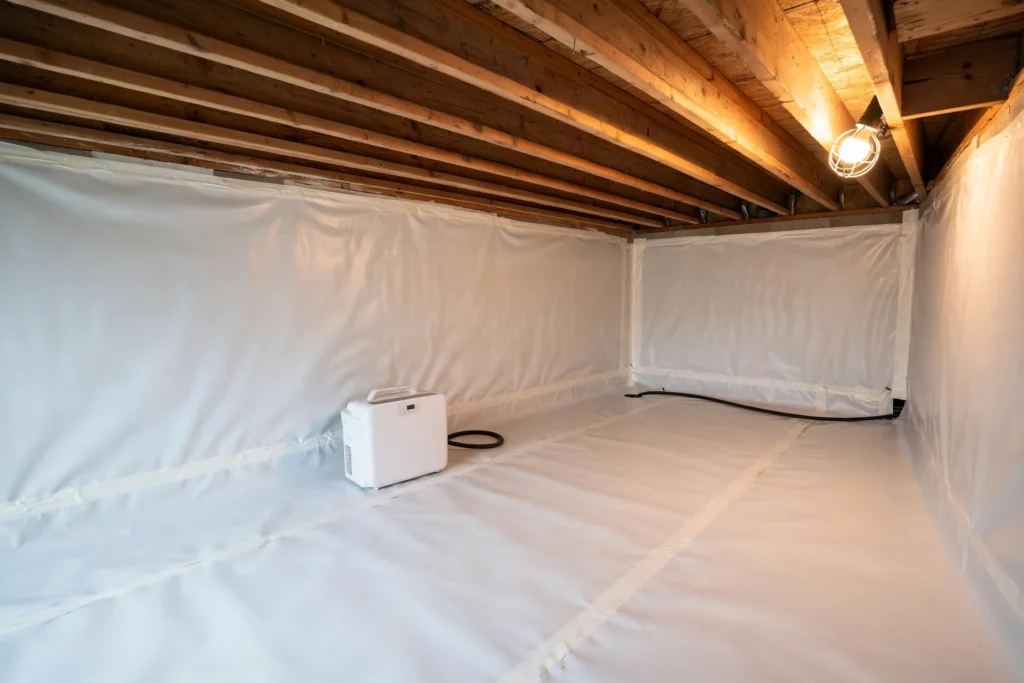
A crawl space is the shallow area between the ground and the first floor of a house, usually 18 inches to 3 feet tall — just enough room to crawl through, which is where the name comes from. It holds plumbing, ductwork, wiring, and insulation, and it is a common foundation type across the United States.
The problem is that a crawl space sits directly on bare soil. Ground moisture evaporates upward all year, and in summer, warm humid air flows in through open vents and condenses on cool surfaces. That is why crawl spaces are almost always the dampest part of a house, and why the air above them often smells musty even when the living rooms look clean.
Do You Need a Dehumidifier in Your Crawl Space?
Not every crawl space needs one, but most vented ones do. A musty smell on the ground floor, especially after rain, is the most common clue. Cupped or warped hardwood floors, condensation on ductwork, and sagging insulation all point to the same cause.
Take a look underneath if you can do so safely. Standing water, white mineral stains on the foundation walls, and dark mold spots on the joists mean the space is already too wet.
A cheap hygrometer left down there for a few days gives you a number: if it regularly reads above 60 percent relative humidity, a dehumidifier for crawl space moisture is worth serious consideration. The U.S. Environmental Protection Agency recommends keeping indoor humidity between 30 and 50 percent.
Seal First, Then Dehumidify
Here is the honest order of operations, and skipping this step is the most common mistake homeowners make. A dehumidifier cannot keep up with a crawl space that is still open to the outdoors. Seal the vents and cover the soil with a heavy vapor barrier before the unit ever arrives.
A vapor barrier is a thick plastic liner, usually 20 mil, laid across the entire floor and run up the foundation walls. It stops ground moisture from evaporating into the space. Sealing the vents keeps humid summer air out. Together, these two steps can cut the moisture load in half, which means a smaller, cheaper dehumidifier does the job.
Does an Encapsulated Crawl Space Need a Dehumidifier?
Yes, in most cases it still does. Encapsulation seals the space, but it does not remove the moisture already trapped inside, and small amounts still seep in through the walls and seams. Without a dehumidifier, an encapsulated crawl space can stay stuck at 60 to 70 percent humidity for months.
Think of it this way: the vapor barrier and sealed vents are the walls of the system, and the dehumidifier is the engine that keeps the air inside them dry. Some very dry climates may get away without one, but for most of the United States, the dehumidifier is what makes encapsulation actually work. It holds humidity at the 50 to 55 percent range where mold and dust mites cannot thrive.
What Size Dehumidifier for Crawl Space?
Sizing is simpler than it looks once the space is sealed. A widely used starting point, reflected in recent editions of the residential building code, is about 70 pints per day at AHAM conditions for every 1,000 square feet of sealed crawl space. For a typical 800 to 1,300 square foot crawl space, a 55 to 70 pint unit is usually right.
Do not size by the old saturation number on the box, which is measured at 90 degrees and 90 percent humidity and looks much bigger than the real-world figure. Look for the AHAM rating instead: pints removed per day at 80 degrees and 60 percent humidity. A unit that is too small runs nonstop and still leaves the space damp, while a unit far too large cycles on and off and wastes electricity. Measure your crawl space footprint first, then match the AHAM rating to it.
Best Dehumidifier for Crawl Space: What to Look For
When you compare the best dehumidifier for crawl space use, start with the shape. Crawl space units are low and wide, usually 12 to 14 inches tall, so they slide through a standard access hatch and fit between the joists. A tall portable unit from the living room will not fit, and it will not survive the cold either.
Check the operating temperature range next. A good crawl space unit keeps working down to about 33 degrees Fahrenheit, with automatic defrost for winter. Look for a built-in humidistat so you can set a target, usually 50 to 55 percent, and let the unit switch itself on and off. A crawl space dehumidifier with pump is worth the extra cost if there is no floor drain nearby, because it pushes collected water uphill and out through a hose instead of relying on gravity. A washable filter and a five-year warranty are signs of a unit built for this job.
My sister put off dealing with her damp crawl space for two summers, until the musty smell reached the hallway and the floorboards started to cup. A sealed liner and a 70-pint unit fixed in one weekend what two years of air freshener never could.
Crawl Space Dehumidifier Installation
Crawl space dehumidifier installation is straightforward for a handy homeowner, but hiring a professional often makes sense too. The unit usually sits on the vapor barrier near the center of the space, with a drain hose running to a floor drain, a sump pump, or outside through the foundation wall.
If you install it yourself, plan the drain route before the unit arrives. Gravity drainage needs a steady downhill slope, while a pump model gives you more freedom. Run the power from a dedicated outlet, and place a separate hygrometer at the far end of the space so you can check the real humidity, not just the reading next to the machine.
Moisture-control and basement-waterproofing contractors do this work every day, and many HVAC companies offer it too. A professional usually bundles the vapor barrier, vent sealing, and the unit into one job. For the EPA’s own mold and moisture guidance, see the U.S. EPA guide to mold, moisture, and your home: U.S. EPA guide to mold, moisture, and your home
How Much Does a Crawl Space Dehumidifier Cost?
A crawl space dehumidifier cost depends on the size of the unit and whether you install it yourself. The unit alone usually runs from about $800 to $1,500 for a good 55 to 70 pint model, with premium pro-grade units reaching $1,800 or more. A model with a built-in pump costs roughly $100 to $200 more.
Professional installation, including the vapor barrier and vent sealing, typically adds $1,500 to $3,000 or more depending on the size of the space and its condition. All in, a full encapsulation plus dehumidifier job often lands between $3,000 and $7,000. That sounds like a lot until you compare it with replacing rotted floor joists or remediating mold, which costs far more. Running costs are modest: most units use about as much electricity as a small refrigerator.
How to Reduce Moisture in Crawl Space
A dehumidifier does the heavy lifting, but a few supporting habits keep the space dry for years. Keep gutters clean and make sure downspouts carry water at least 6 feet away from the foundation, so rain does not pool against the house. Grade the soil around the foundation so it slopes away from the walls.
Inside the space, check the vapor barrier seams once a year and re-tape any that have lifted. Keep the filter clean, and check the drain hose for kinks or clogs every few months. If your home has dampness in other spots too, the same logic applies on a smaller scale, as our guide to bathroom moisture explains: dehumidifier for bathroom
Pests are another reason to keep the space dry. Silverfish love the same damp, dark conditions that mold does, and drying the crawl space helps across the whole house, as our silverfish guide explains: dehumidifier for silverfish
Frequently Asked Questions
How to dehumidify a crawl space?
Seal the vents, lay a vapor barrier over the soil, then install a low-profile dehumidifier sized to the space, usually 55 to 70 pints per day for a typical home. Set the humidistat to 50 to 55 percent and give the unit a drain route, either gravity or a condensate pump.
Who installs crawl space dehumidifiers?
Moisture-control and basement-waterproofing contractors install them most often, and many HVAC companies offer the service too. A professional usually bundles the vapor barrier, vent sealing, and the unit into one job. A handy homeowner can install the unit alone if the space is already sealed and a drain route is planned.
How much is a dehumidifier for crawl space?
The unit alone usually costs $800 to $1,500 for a good 55 to 70 pint model, with premium units reaching $1,800 or more. A built-in pump adds roughly $100 to $200. Professional installation with encapsulation typically brings the full job to $3,000 to $7,000 depending on the size and condition of the space.
Final Thoughts
A dehumidifier for crawl space moisture is not a luxury purchase. It protects the floor you walk on, the air you breathe, and the structure holding your house up. Seal the vents, lay the vapor barrier, size the unit to your space, and give it a drain route. Do those four things, and the space under your house stops being a problem you ignore and becomes a part of the home that simply stays dry.
If dampness is a whole-house problem rather than a crawl space problem, a single system may serve the entire home better, as our complete whole house dehumidifier guide explains: whole house dehumidifier For a deeper look at basement moisture, which follows the same rules on a bigger scale, see our basement moisture control guide: dehumidifier for basement moisture control