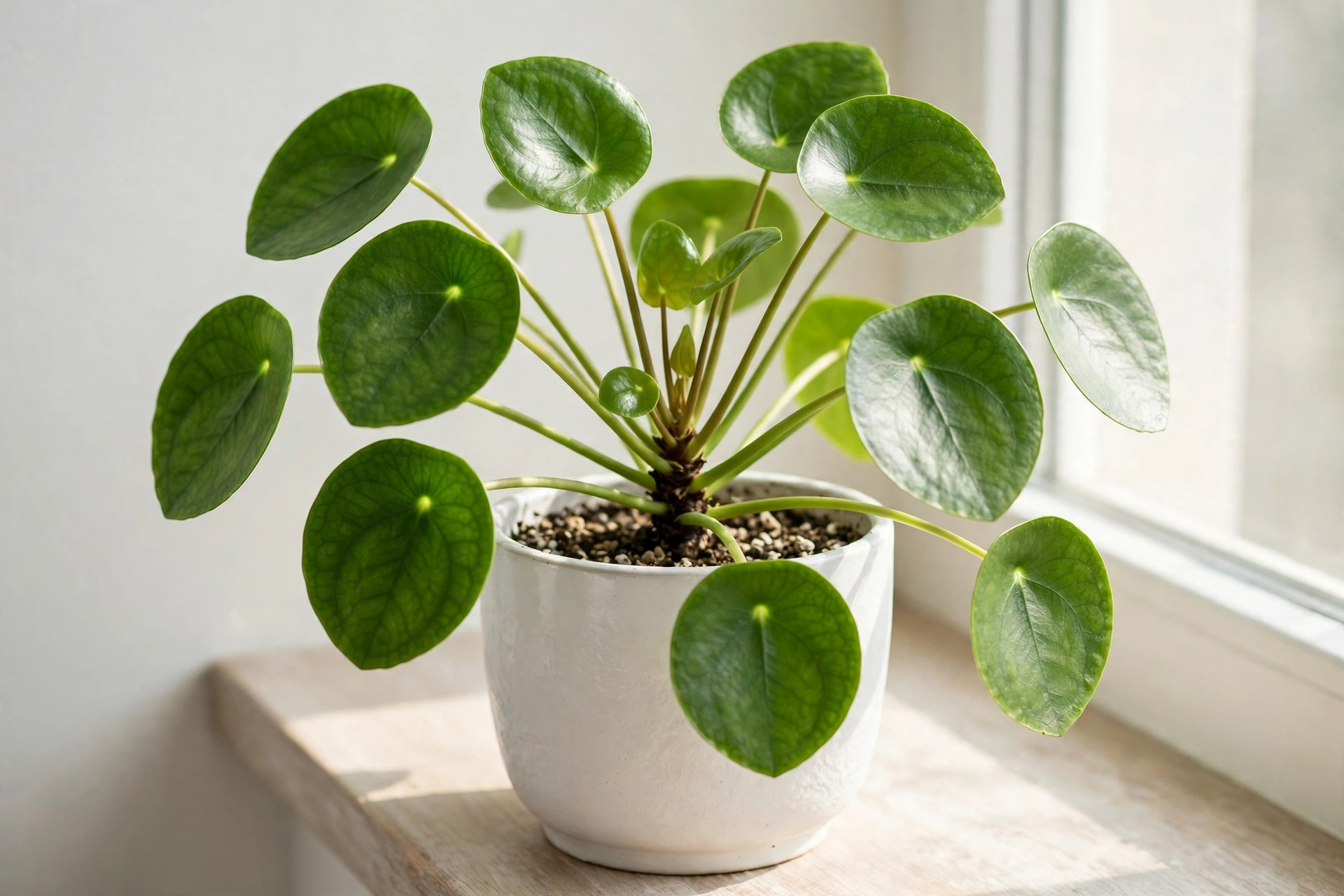
Pilea peperomioides is the houseplant that looks like a handful of green coins floating on thin stems. Better known as the Chinese money plant, pancake plant, UFO plant, or friendship plant, this cheerful pilea plant has become one of the most shared houseplants in the world, and for good reason. It is easy to care for, grows fast, and hands you free baby plants to pass along to friends. This guide covers everything a pilea peperomioides houseplant needs: the right light, how often to water, the best soil, propagation, and how to fix the common problems of drooping, yellow, and curling leaves.
The pilea peperomioides Chinese money plant earned its friendship-plant nickname honestly. It spread around the world not through garden centers but as cuttings shared from one windowsill to another, starting with a Norwegian missionary who brought it home from Yunnan province in southern China in the 1940s. That history is still the best thing to know about the plant, because a healthy pilea peperomioides propagates so freely that one plant turns its owner into the person who always has a baby plant to give away.
Pilea Peperomioides at a Glance
- Light: bright, indirect light; an east- or west-facing window is ideal.
- Water: when the top 1 to 2 inches of soil feel dry; roughly weekly in summer, every 10 to 14 days in winter.
- Soil: rich, well-draining houseplant mix with perlite; pH 6.0 to 7.0.
- Temperature: 60 to 85°F indoors; keep it above 50°F.
- Humidity: average household humidity is fine; 40 to 60 percent is ideal.
- Feeding: half-strength balanced liquid fertilizer, monthly in spring and summer only.
- Mature size: about 12 inches tall and 8 to 12 inches wide.
- Pets: considered non-toxic to cats and dogs.
That is the whole routine. The sections below explain each part, including how to take care of a pilea peperomioides through its fast first year and what to do when the leaves start telling you something is wrong.
What a Pilea Peperomioides Is
So what is pilea peperomioides, exactly? It is a perennial in the nettle family, Urticaceae, native to the mountains of Yunnan in southwestern China. Its signature is the round, flat, glossy leaf, 2 to 4 inches across, held on a long petiole that joins the leaf near its center, so each leaf looks like a little green coin on a stick. A mature pilea peperomioides plant grows upright on a central stem, reaching about 12 inches tall and 8 to 12 inches wide, and older plants slowly shed their lower leaves and develop a short, bare trunk with a tuft of coins on top.
How big can pilea peperomioides grow, and how fast? In good light it can double in size within a year, and a young plant fills a 4-inch pot within months. How tall it gets depends mostly on age and light: a plant kept in bright light stays compact and full, while one in dim light stretches, grows leggy, and produces smaller leaves. It is a fast grower by houseplant standards, which is why it outgrows its pot and starts producing pups so quickly.
Do pilea peperomioides flower? Mature plants sometimes do, sending up tiny white flowers on thin stalks in spring. The flowers are small and easy to miss, and most growers consider them a curiosity rather than a feature. A short spell of cool temperatures in winter can encourage blooming, but nobody grows this plant for its flowers. The Spruce’s Chinese money plant guide notes the same thing: it seldom flowers indoors, and the round leaves are the whole show. For a second expert take on the basics, see The Spruce’s guide.
Light: Bright, Indirect Light and the Weekly Turn
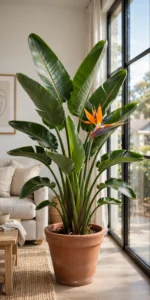
How much light does pilea peperomioides need? More than most people expect. Give it bright, indirect light: a spot near an east-facing window with gentle morning sun, or a few feet back from a south- or west-facing window. Like the bird of paradise plant, which also loves bright filtered light, pilea does its best work when it can see plenty of sky without sitting in harsh direct sun. Read our bird of paradise plant care guide here.
Direct midday sun through glass scorches the thin leaves, leaving pale bleached patches and crispy brown edges. Too little light causes the opposite problem: the stems stretch, the spaces between leaves widen, and new coins come in noticeably smaller. If your plant is growing lopsided or the leaves keep getting smaller, light is the first thing to check.
The defining quirk of pilea peperomioides care is the lean. Every petiole angles itself toward the brightest light it can find, so a pot left facing the same way for weeks tilts toward the window until the whole plant points out of the room. The fix is simple and worth making a habit: give the pot a quarter turn every week. Rotated regularly, the plant grows straight and symmetrical, filling out into the flat, even disc it is meant to be.
Watering: How Often to Water a Pilea Peperomioides
How often to water pilea peperomioides is the question that decides whether the plant thrives or struggles, and the honest answer is to check the soil, not the calendar. Water thoroughly when the top 1 to 2 inches of soil feel dry, then let the pot drain completely and empty the saucer. For most indoor pots that means about once a week in spring and summer, and every 10 to 14 days in fall and winter, when growth slows. My neighbor keeps hers on an east-facing kitchen windowsill and says the only rule that matters is checking the soil before watering, never watering on a fixed day.
When to water is easier to judge once you know the plant’s own signal: pushed too far between waterings, the whole plant droops, petioles and all. A thirsty pilea usually perks up within hours of a good drink, which makes drooping a useful alarm rather than a disaster. But drooping can also mean the roots are sitting in soggy soil, so always check before you water. If the soil is wet and the plant is drooping, the problem is overwatering, not thirst.
Overwatering kills more pileas than any other mistake. Water only when the soil has dried at the depth of your finger, never let the pot sit in standing water, and use a pot with drainage holes every time. In winter, stretch the interval even if the leaves look slightly less plump; a pilea in a cool, dim room drinks far more slowly than the same plant in July.
Soil, Pot, and Repotting
The best soil for pilea peperomioides is a standard, well-draining houseplant mix with a generous handful of perlite or orchid bark mixed in, so air reaches the roots and excess water drains away. A peat- or coir-based mix with a pH between 6.0 and 7.0 suits it well. Avoid heavy, dense mixes that stay wet, and avoid succulent soil, which drains too fast and holds too little moisture for this plant.
What pot does it want? Any pot with drainage holes works, and terracotta is a good choice because it lets the soil dry evenly, though you may need to water slightly more often. A pilea peperomioides likes to be a little snug in its pot and does not mind being slightly root bound, so do not rush to repot a plant that is still growing well.
When to repot is easy to spot: roots circling out of the drainage hole, water running straight through without wetting the mix, or growth stalling in spring despite good light. Repot in early spring or summer, choosing a pot just 1 to 2 inches wider than the old one, and separate any pups at the same time. Going much bigger invites soggy soil, which is the one thing this plant truly hates.
Temperature and Humidity
Pilea peperomioides is happy at normal room temperature, between 60 and 85°F. Indoors, avoid exposing it to temperatures below 50°F, and keep it away from cold drafts near doors and windows in winter, as well as hot, dry air from heating vents and radiators. Sudden temperature swings stress the plant and can trigger leaf drop.
Do pilea peperomioides like humidity? They appreciate it, but they do not demand it. Average household humidity of 40 to 60 percent is fine, and most homes provide that without any extra effort. Misting is not necessary, though in a very dry winter home a nearby humidifier or a pebble tray can keep the leaf edges from crisping. If the leaf edges turn brown and papery, low humidity is one of the first suspects, along with too much direct sun.
Feeding Through the Growing Season
Feed a pilea monthly from spring to late summer with a balanced liquid fertilizer mixed at half strength. It grows quickly in the warm months, and regular light feeding keeps the new leaves large and deep green. Stop feeding in fall and winter, when growth slows; fertilizer given to a dormant plant can burn the roots. If you repot in spring with fresh mix, you can skip feeding for the first month, since the new soil already carries nutrients.
Pilea Peperomioides Propagation: Sharing the Pups
Pilea peperomioides propagation is the reason this plant is called the friendship plant. A healthy pilea produces pups: small baby plants that pop up from the soil around the base of the mother plant, and sometimes small shoots from the stem itself. Like a spider plant, which hands you plantlets on long runners, a pilea hands you ready-made babies at its feet. See our spider plant care guide for another generous propagator.
How to propagate pilea peperomioides is simple. Wait until a pup is 2 to 3 inches tall with a few leaves of its own. Dig gently around its base to find where it connects to the mother plant, then cut it free with clean scissors, keeping a bit of root if you can. Pot it right away in a small pot of moist, well-draining mix, keep the soil damp but not soggy, and give it bright, indirect light. A pup with roots settles in within a week or two.
Can pilea peperomioides grow in water? Yes, for rooting. A pup cut without roots, or a stem cutting, roots happily in a small glass of water, usually within one to two weeks. Change the water every few days, and pot the cutting up once the roots are an inch or two long. Water rooting is also the rescue route for a leggy old plant: cut the crown with a few inches of stem, root it in water, and the old stem will often sprout new babies of its own.
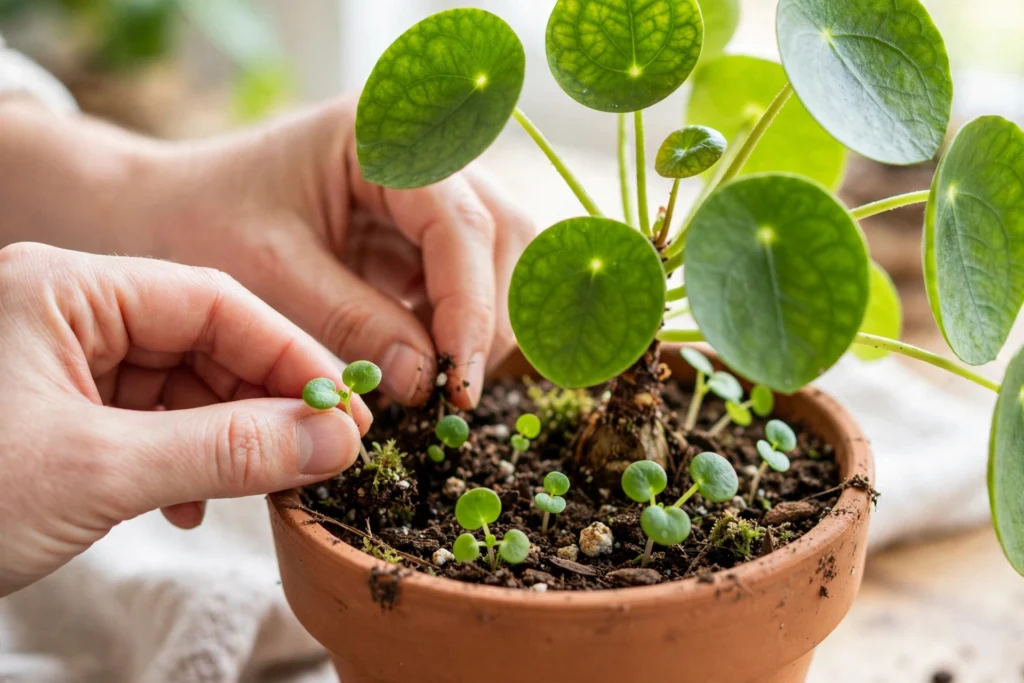
How to separate pilea peperomioides pups that grow from the stem is the same idea: cut the shoot off with a little stem attached and root it in water or moist mix. One method that rarely works is growing a new plant from a single leaf. A leaf cutting may root, but it almost never grows into a full plant, so stick with the pups. As for pilea peperomioides seeds, they are rarely the way anyone grows this plant: it seldom sets seed indoors, and seed-grown plants are slow and unpredictable. Pups are faster, free, and true to the parent, which is why every pilea owner ends up giving them away.
Making a Pilea Full and Bushy
How to make pilea peperomioides bushy comes down to three habits: plenty of bright, indirect light, a weekly quarter turn so growth stays even, and removing the oldest leaves as they fade. Young plants are naturally full; it is older plants that go bare at the base as lower leaves drop off.
How to prune pilea peperomioides is gentle work. Snip off yellowed or damaged leaves at the base of their petioles, and trim a leggy stem back to just above a node if the plant has stretched. If an old plant has grown tall and bare, topping it is the boldest fix: cut the crown off with a few inches of stem, root it in water as described above, and keep the old stem watered. It will often push out fresh pups from the base, giving you two plants where you had one tired one.
Troubleshooting: Drooping, Yellow, Curling, and Dropping Leaves
Why is my pilea peperomioides drooping? Check the soil first. Dry soil means it is thirsty, and a deep watering should revive it within hours. Wet soil with a drooping plant means the roots are waterlogged: stop watering, let the mix dry out, and make sure the pot drains freely. How to revive pilea peperomioides after either problem is the same slow fix: correct the watering, move it back to bright indirect light, and give it a week or two before judging. Remove any leaves that have turned fully yellow or mushy, since they will not recover.
Why is my pilea peperomioides turning yellow? Yellow leaves that eventually fall off are the classic sign of too much water. Ease off, confirm the soil dries between waterings, and check that the pot is not sitting in a saucer of water. A single yellow leaf at the base of an old plant is normal aging, not a crisis.
Why is my pilea peperomioides dropping leaves? Leaf drop usually traces to a sudden change: a cold draft, a move to a much darker spot, or a watering swing from soaked to bone dry. Keep the plant in one good spot, water steadily, and protect it from doors and vents.
Why is my pilea peperomioides leaves curling? Curling leaf edges can mean the light is too low, the room is too hot, or the humidity is too dry. Overwatering and underwatering can both curl the leaves too, which is why the soil check comes first. If the leaves dome upward like little umbrellas, the plant is usually reaching for more light: move it closer to the window gradually over a week, and rotate it so the growth evens out.
Common Pests to Watch For
Pilea peperomioides is not prone to any particular pest, but indoors it can pick up the usual houseplant visitors: mealybugs, scale, fungus gnats, and spider mites. Check the undersides of leaves when you water, and wipe off any cottony clusters or tiny webs with a damp cloth or a cotton swab dipped in rubbing alcohol. Fungus gnats are almost always a sign of soil staying wet too long, so letting the top of the mix dry out between waterings is both the cure and the prevention.
Safe Around Cats and Dogs
Good news for pet owners: pilea peperomioides is considered non-toxic to cats and dogs, and it is not listed as a toxic plant by the ASPCA. It is one of the safer houseplants to keep in a home with curious pets, which is part of why it shows up on so many pet-friendly plant lists. Even so, it is an ornamental plant, not a snack, so keep it out of easy reach of pets who like to chew leaves, and the same goes for small children.
Where to Buy a Pilea Peperomioides
Where to buy pilea peperomioides is easy to answer now that the plant is widely grown: most local garden centers and nurseries stock it, and online plant shops ship it across the US. Searching for pilea peperomioides near you will usually turn up a nursery within driving distance, and the plant is common enough that prices are modest. Buy a small plant rather than a large one if you can: it grows fast, costs less, and you get to watch it fill out. Before you buy, check that the leaves are flat, deep green, and free of yellow edges, and look at the base for pups, which are a sign of a healthy, vigorous plant.
Growing a Pilea Outdoors and Through the Seasons
Can pilea peperomioides grow outside? Yes, in warm climates. Outdoors year-round it suits USDA zones 10 to 12, where temperatures stay above freezing. In colder zones, treat it as a summer patio plant: move it outside once nights stay above 55°F, give it a shaded or partly shaded spot out of harsh midday sun, and bring it back indoors well before the first cold snap. A sudden chill below 50°F can damage the leaves, so watch the forecast in fall.
Through the seasons, pilea care follows the plant’s own rhythm. Spring and summer are for growth, feeding, repotting, and sharing pups. Fall is for easing off water and fertilizer as the days shorten. Winter is for holding steady: bright light, careful watering, and no feeding. A plant that gets this seasonal rhythm right will reward you with big flat coins, a steady stream of pups, and the occasional tiny white flower in spring.
Final Thoughts
Pilea peperomioides asks for very little and gives back a lot: a sculptural little plant, a weekly ritual of turning the pot, and a steady supply of baby plants to share. Give it bright, indirect light, water when the soil dries, and a pot that drains, and it will fill your windowsill for years. If you enjoy plants that multiply, our spider plant care guide covers another generous propagator — and if you want a bigger statement plant for the same bright spot, the ficus tree care guide is a good next read.
How do you pronounce pilea peperomioides?
Say it as py-LEE-uh pep-er-oh-MY-deez. The genus name Pilea comes from the Latin word for a cap, a nod to the shape of the flower, and peperomioides means “resembling a peperomia,” which is a little misleading, as the next answer explains.
Is pilea peperomioides a succulent?
No. Its thick, glossy leaves store a little water, which is why people often mistake it for a succulent, but botanically it is not one. Do not treat it like a succulent: it needs regular watering when the top of the soil dries, and it will suffer in the dry, infrequent watering routine a true succulent enjoys.
Is pilea peperomioides a peperomia?
No, despite the similar name. Pilea peperomioides belongs to the nettle family, Urticaceae, while peperomias belong to the pepper family, Piperaceae. The species name only means the plant resembles a peperomia, not that it is one.