A creeping fig is the plant that turns a plain brick wall into a living green tapestry. This small-leafed vine, Ficus pumila, also sold as climbing fig or fig ivy, clings to walls, fences, and tree trunks with tiny aerial roots and covers them in a dense mat of heart-shaped leaves. It asks for surprisingly little: decent light, water when the soil dries, and a firm hand with the pruners once it gets going. This guide covers creeping fig care indoors and outdoors, how to grow creeping fig on a wall, how fast it grows, and the few real risks worth knowing before you plant it.
So what is a creeping fig, exactly? Its scientific name is Ficus pumila, a woody evergreen vine in the mulberry family, native to East Asia — southern China, Taiwan, Japan, and Vietnam. It is a true creeping fig plant in both senses of the name: outdoors it creeps along the ground as a low mat, and given anything vertical it climbs, gripping with adhesive rootlets that secrete a sticky latex. The same plant can behave like a ground cover, a wall vine, or a potted trailer, which is why it shows up in so many gardens and living rooms.
What a Creeping Fig Looks Like: Two Very Different Leaf Stages
The most surprising thing about a creeping fig vine is that one plant grows two kinds of leaves. The juvenile stage — the one you see on young plants and most indoor pots — has small, thin, heart-shaped leaves under an inch long, overlapping like roof tiles. New leaves often emerge burgundy, then fade through bronze and copper to light green.
The mature stage appears only on older outdoor vines. Its leaves are much larger, 2 to 4 inches long, darker green, thicker, and leathery, on stems that grow woody and shrubby and pull away from the wall. Clemson Cooperative Extension describes both stages clearly, and its climbing fig fact sheet is the botanical reference behind this guide.
A creeping fig ficus pumila grown indoors almost always stays in the juvenile stage, which is exactly what most people want: tiny leaves, tight coverage, and a plant that stays delicate rather than turning into a woody shrub. If your outdoor vine suddenly throws out big, coarse leaves on thick stems, it has simply matured. Prune those mature shoots back to where they attach and the plant returns to its neat, small-leafed look.
Creeping Fig Care at a Glance
- Light: bright, indirect light indoors; full sun to shade outdoors.
- Water: when the top inch of soil feels dry; consistently moist, never soggy.
- Soil: loose, fast-draining potting mix or garden soil with good drainage.
- Temperature: 60 to 75°F indoors; hardy outdoors in USDA zones 7b to 11.
- Humidity: average household humidity is fine; 40 to 60 percent is ideal.
- Feeding: half-strength balanced liquid fertilizer, monthly in spring and summer only.
- Pruning: in spring and through the growing season, to keep it in bounds.
That is the whole routine. The sections below explain each part, including how to take care of a creeping fig through its slow first year and its much faster years after that.
Light: How Much Sun a Creeping Fig Needs
Creeping fig light needs are flexible, which is part of its charm. Indoors, give it the brightest indirect light you can — a few feet back from a sunny window, or beside an east-facing window with gentle morning sun. It tolerates medium light, but growth slows, the spaces between leaves stretch, and the plant looks thin.
Direct midday sun through glass scorches the small leaves, leaving pale, bleached patches and crispy edges. Keep it out of a hot south- or west-facing window unless a sheer curtain filters the light. Outdoors, the rules relax: a creeping fig can grow in full sun and it can grow in shade — Clemson notes it thrives in both — though in very hot climates a little afternoon shade keeps the leaves from scorching.
So the honest answer to whether it needs sun is: it needs light, not necessarily direct sun. Low light is the most common reason an indoor creeping fig stalls. If yours has not grown in months, move it closer to the window gradually over a week or two rather than all at once.
Watering: How Often to Water Creeping Fig
How often to water creeping fig is the question that decides whether the plant lives or dies, and the answer is to check the soil, not the calendar. Water when the top inch of soil feels dry — for most indoor pots that means about every 7 to 10 days in spring and summer, and every 10 to 14 days in fall and winter, when growth slows. How much water it needs depends on pot size, light, and temperature, so use your finger rather than a fixed schedule. My friend keeps hers in a terracotta pot by an east window and says the only rule that matters is never letting it sit in a puddle.
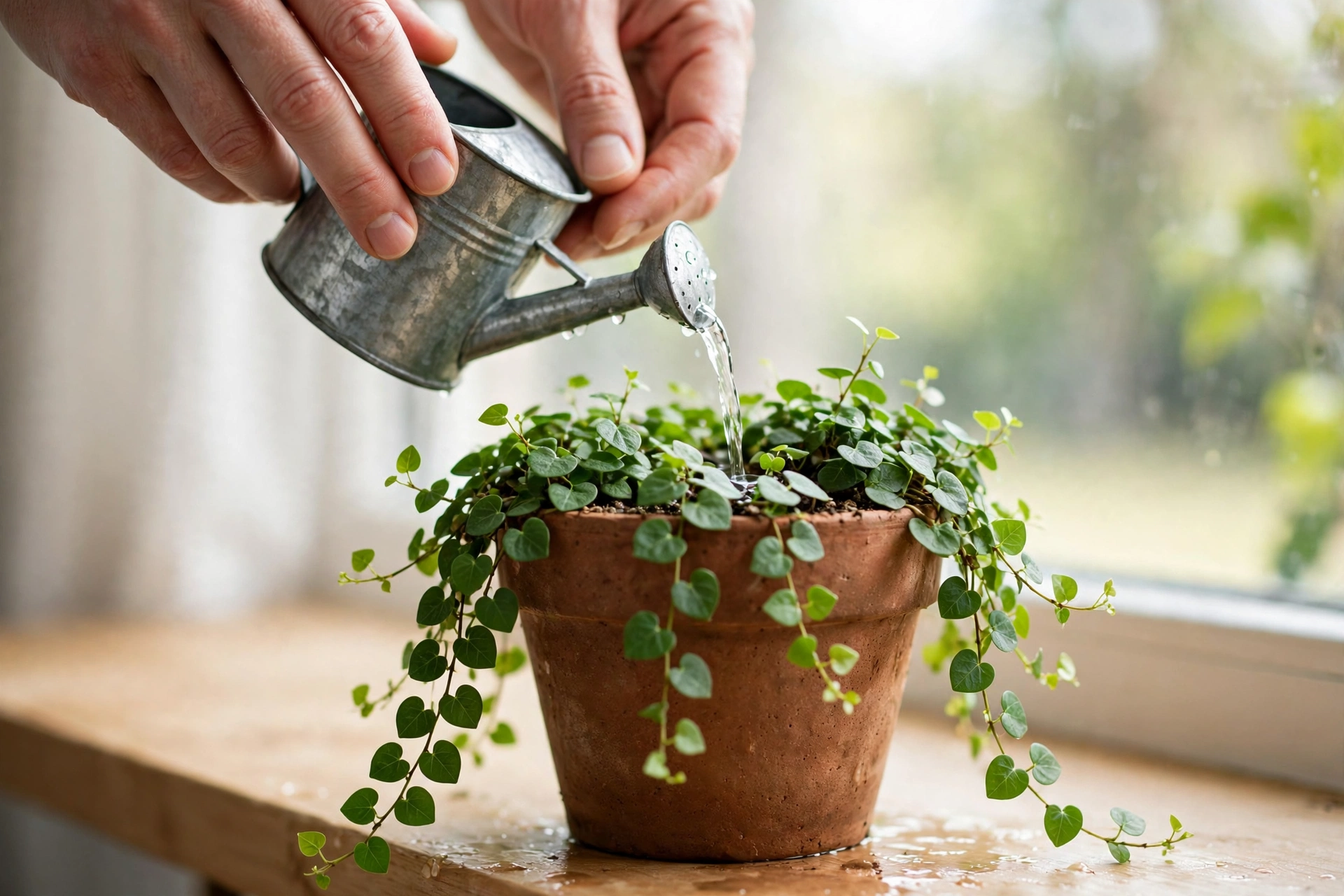
Water slowly until it runs freely from the drainage holes, then empty the saucer within 15 minutes. The roots are shallow and fine, so they rot quickly in standing water — overwatering is the fastest way to kill a creeping fig plant indoors. The warning signs are yellowing lower leaves and soft stems at the base.
Underwatering shows up differently: the leaf edges turn crispy and brown, and the plant sheds leaves from the tips inward. If your creeping fig is drying out or looking crispy, check the soil first. Bone-dry soil means a deep soak; soggy soil means stop watering and let it dry. A plant that is only thirsty usually perks up within days of a good watering.
Outdoors, an established creeping fig vine is more forgiving. Once its roots are down, it tolerates short dry spells and shows moderate drought tolerance, but it still grows far better with steady moisture in its first year. Water a new outdoor planting deeply once or twice a week through its first summer, then ease off as it establishes.
Soil, Pot, and Repotting
The best soil for creeping fig is loose and fast-draining but still holds a little moisture. A standard indoor potting mix with a handful of perlite or orchid bark mixed in works well. Heavy, peaty bagged mix compacts around the fine roots, so open it up before planting.
In the garden it is not fussy about soil type — it will grow in clay soil as long as water does not pool around the roots — but it sulks in ground that stays waterlogged. You can grow creeping fig in a pot very happily: a hanging basket, a small terracotta pot on a windowsill, or a container trained up a moss pole all suit it.
Choose a pot with drainage holes and go just one size up when repotting, every 2 to 3 years in spring, or when roots circle the drainage holes. A pot that is far too big holds wet soil the roots cannot use, and that is where rot starts.
Growing Creeping Fig on a Wall
This is where the plant earns its name. To grow creeping fig on a wall, plant young plants 1 to 2 feet apart at the base of the wall — closer spacing fills in faster — and guide the stems toward the surface. The stems do the rest: tiny aerial rootlets and adhesive pads grip brick, stone, concrete, and rough wood on their own. No ties or trellis are needed; a creeping fig does not need a trellis at all, and it climbs far better on a rough, flat surface than on a smooth one.
How to get creeping fig to stick to a wall is mostly a matter of patience and contact. Keep the stems pressed against the surface and the air around them a little humid while they root — a light misting of the wall on dry days helps young stems attach. Once attached, do not pull a stem off to reposition it; the adhesive pads stay behind and the stem will not reattach in the same spot.
To make creeping fig climb faster, give it warmth, light, and water: a plant in bright light with steady moisture climbs far faster than one in a dark, dry corner. If you want it to follow a particular route, pin the young stems flat against the wall with small plant clips until the rootlets take hold, then remove the clips. The vine can also grow downwards — let it trail from a high planter or a retaining wall and it spills over the edge in a green curtain.
Before you commit a wall to it, understand the trade-off. A creeping fig can damage brick walls and other surfaces, not while it grows but when it is removed: the adhesive pads and rootlets often stay stuck, and pulling mature stems off soft mortar, painted wood, or stucco can take flakes of the surface with them. Sound, hard brick usually survives fine, but never plant it on a wall you expect to strip clean one day, on crumbling mortar, or on wood siding you care about. Plant it at least a foot out from the wall so air circulates behind the stems, and keep it off window frames, gutters, and rooflines from the start.
Creeping Fig as Ground Cover
As a creeping fig ground cover, the plant behaves completely differently: with nothing to climb, it spreads sideways into a dense, low mat less than 2 inches high, smothering weeds and softening the edge of a path or a slope. Plant it 1 to 2 feet apart and it knits together within a season or two in warm climates.
It also grows horizontally with enthusiasm, which is why the same plant that looks charming on a wall can swallow a small bed if you turn your back. How to keep creeping fig from spreading is simple but not optional: shear the edges twice a year, pull runners that cross into beds, and never let it reach a tree you want to keep bare — it will climb that too.
Is creeping fig invasive? In warm, frost-free regions it can spread aggressively, and it has naturalized in parts of the southeastern United States, so check your local guidance before planting it in the ground in zones 9 to 11. Indoors or in a pot it is no threat at all, and in cold-winter regions frost does the pruning for you.
How Fast Does Creeping Fig Grow?
Growth speed is the part that surprises new owners most. The first year is slow: the plant spends its energy building roots, and you may see only a few inches of new growth. After that, an established outdoor vine grows about a foot a year in its juvenile stage, and faster in warm climates once it is settled. A wall can go from patchy to covered in two or three growing seasons.
Indoors, growth is slower — a few inches a year in average light, much faster in a bright window. How long it takes to grow into a full wall covering depends on spacing, sun, and warmth, but plan on two to three years for a good-sized wall from small pots.
To get creeping fig to grow faster, give it what it wants most: bright light, steady moisture, and warm temperatures through the growing season. A monthly half-strength feeding in spring and summer helps, but fertilizer alone cannot rescue a plant in a dark corner.
When to plant creeping fig outdoors is spring, after the last frost, so it has a full warm season to root before winter. It is evergreen in warm zones, holding its leaves through winter, and in zone 7 it may lose leaves in a hard freeze but usually comes back from the roots in spring. If your vine looks dead after a cold snap, wait for new growth before digging it up. In USDA zones 7b to 11 it is hardy outdoors year-round; below that, grow it in a pot and bring it inside before frost.
Pruning and Training: Keeping It in Bounds
Pruning is not optional with a creeping fig vine — it is the care task. Prune in spring and through the growing season with clean, sharp shears, cutting back any stems that wander past the area you want covered. Never remove more than a third of the plant at once, and step back to look at the shape before the next cut.
Regular light trimming keeps the juvenile leaves small and dense; neglect it for a year and the mature, woody growth takes over. How to train creeping fig is a matter of guiding, not forcing: point young stems where you want them, pin them flat until they grip, and prune anything that heads the wrong way.
To remove creeping fig from a wall or from stucco, cut the stems at the base and let the upper growth die and dry before pulling it away — dry stems release more cleanly than live ones, though some adhesive pads will remain and may need a stiff brush or a pressure washer on hard masonry. Wear gloves: the milky sap can irritate skin, and on stucco the pads can leave marks even after the plant is gone.
If a vine has truly outgrown its welcome, cutting it to the ground and digging out the roots is the reliable way to get rid of creeping fig for good. Herbicide is rarely needed and should be a last resort.
Creeping Fig Propagation
Creeping fig propagation is one of the easiest wins in the garden. The juvenile stems root readily without any rooting hormone. The simplest method is a stem cutting: in spring, snip a 4- to 6-inch piece just below a leaf node, strip the lower leaves, and set it in a jar of clean water on a bright windowsill or straight into moist potting mix.
Roots usually appear in 2 to 4 weeks — change the water weekly so it stays fresh — and pot the cutting once roots reach an inch or two. Yes, a creeping fig can grow in water long enough to root, though it should be potted up once roots form rather than left in the jar indefinitely.
You can also grow creeping fig from cuttings laid flat on damp soil and pinned down; each node can root where it touches the mix. Layering works the same way outdoors: pin a low stem to the soil, cover the node lightly, and cut it free once it has rooted.
Varieties Worth Knowing: Variegated and Oak Leaf
The plain green type is the fastest grower, but the varieties are what catch the eye. A variegated creeping fig, usually sold as Ficus pumila ‘Variegata’, ‘Snowflake’, or ‘Sunny Fig’, has cream or white edges on its small leaves and brightens a shady wall. It grows more slowly than the green form and needs a little more light to hold its variegation.
The oak leaf creeping fig, Ficus pumila var. quercifolia, has tiny lobed leaves shaped like miniature oak leaves and is a favorite for terrariums and small pots. Ficus pumila ‘Minima’ has even tinier leaves and suits hanging baskets, while ‘Curly’ has crinkled, wavy foliage. All of them want the same care as the standard plant, just with a little more light for the variegated forms.
Fruit, Flowers, and Edibility
A mature creeping fig does produce fruit: pale green, pear-shaped figs about 3 inches long on outdoor vines that have reached the mature stage. The flowers are hidden inside the fig, pollinated by a tiny fig wasp, so you will never see a showy bloom.
Can you eat creeping fig fruit? No — the fruit is considered inedible, and the raw figs are not food. The plant is grown for its foliage, not its fruit, and the figs are best left for the birds or pruned away with the mature growth that bears them.
Pets and Safety: Is Creeping Fig Toxic?
Creeping fig is mildly toxic to pets and irritating to people. Like other figs, it produces a milky sap that can irritate skin and, if chewed, the mouth and stomach. Ficus species are listed as toxic to cats and dogs, and a pet that chews the leaves may drool, vomit, or go off its food for a day. Serious poisoning is rare, but the plant is not a safe choice for a home where a cat treats every trailing leaf as a snack.
Wear gloves when you prune, wash your hands after handling cut stems, and keep the plant out of easy reach of curious pets. The sap can also cause a sun-sensitive skin reaction in some people, so avoid pruning in bright sun with bare arms.
If you want the same trailing habit without the worry, our spider plant care guide covers a completely non-toxic plant that forgives missed waterings and trails just as prettily from a hanging basket. And if the wall-covering habit is what you love but you want a tree instead of a vine, our ficus tree care guide covers the weeping fig — the same genus, a much calmer routine, and no adhesive roots to manage.
Why Is My Creeping Fig Dying?
A creeping fig that is dying is almost always reacting to water, light, or cold — not to disease, which is rare in this plant. Work through the causes in order. Soggy soil with yellowing leaves means overwatering: stop watering, let the soil dry, and check that the pot drains.
Crispy, brown leaf edges with dry soil mean underwatering or dry air: soak the pot well and water more often. A plant that will not grow at all is usually in too little light: move it closer to a bright window and wait a month. Cold damage looks like blackened, limp leaves after a frost — trim the damaged stems in spring and let it regrow.
To revive a creeping fig that still has some green stems, cut back the dead growth, water it well, put it in bright indirect light, and leave it alone for a few weeks. As long as the roots are alive, it usually comes back. If every stem is brown and brittle right down to the soil and nothing sprouts after a month of good care, the plant is dead and it is time to start fresh with a cutting.
Indoor or Outdoor: Where a Creeping Fig Belongs
Can creeping fig grow indoors? Yes — it is an excellent indoor plant in a hanging basket, a small pot on a bright windowsill, or a terrarium, where it stays small-leafed and well behaved. It will not die indoors as long as it gets bright indirect light and water when the top inch of soil dries.
A dark corner and constant wet feet are what kill it inside. Outdoors it belongs in USDA zones 7b to 11, on a wall, a fence, or as ground cover, where it grows fastest and looks its best. In colder zones, grow it in a container and bring it inside before the first frost — it makes the move happily if you do it before the cold arrives rather than after.
If your indoor jungle is growing and you want a bolder statement plant for the same bright window, our fiddle leaf fig care guide walks through a slightly fussier favorite step by step. Start with the creeping fig, and the rest of the collection follows naturally.
Final Thoughts
A creeping fig earns its place honestly: it is tough, fast once established, and turns the plainest wall into something worth looking at. Give it bright light, water when the soil says so, and a firm hand with the pruners, and it will cover a wall, soften a fence, or trail from a basket for years. The only real mistake is planting it somewhere you cannot reach with shears — because this is one vine that always keeps its side of the bargain, and then some.
Where can I buy a creeping fig?
Creeping fig is sold at most garden centers and nurseries, usually as a small 4-inch pot, and from online plant shops that ship houseplants. Look for the plain green Ficus pumila for the fastest growth, or ask for ‘Snowflake’ or ‘Sunny Fig’ if you want the variegated form. Buy in spring if you plan to grow it outdoors, so it has a full warm season to establish.
Is creeping fig deer resistant?
Creeping fig is generally considered deer resistant — deer usually leave it alone and prefer other plants. It is not completely deer-proof, and a hungry deer may still sample young growth, but it is rarely a first choice for browsing, which is one reason it survives so well as an outdoor ground cover and wall vine.
Will creeping fig grow on a chain link fence?
Yes, creeping fig will grow on a chain link fence. Its stems thread through the mesh and grip with adhesive rootlets, covering the fence in a dense green screen within a season or two in a warm climate. Train young stems through the mesh early, and remember it is hard to remove from a fence later — prune it back before it reaches the top rail or your neighbor’s side.