A nerve plant looks like a small piece of art. Its dark green leaves carry a fine net of bright veins in white, pink, or red, and the pattern is so neat that it looks painted on. This nerve plant care guide covers everything a beginner needs: light, water, soil, humidity, feeding, propagation, and the fixes for the problems that make this plant famous — including its dramatic faint.
My sister keeps one on her kitchen windowsill, and the first time it flopped flat she was sure it was dead. An hour after a good drink of water, it stood right back up. That is the nerve plant in one story: fussy about moisture, quick to complain, and quick to forgive.
Nerve Plant at a Glance
- What it is: Fittonia albivenis, a low-growing tropical houseplant from the rainforests of South America.
- Other names: mosaic plant, silver net leaf, painted net leaf.
- Height: 3 to 6 inches tall; it spreads wider than it grows tall.
- Spread: 6 to 12 inches across as it creeps outward.
- Light: bright, indirect light; no direct sun.
- Water: keep soil evenly moist; water when the top half inch feels dry.
- Soil: rich, well-draining mix; pH 6 to 7.
- Temperature: 65 to 80 degrees Fahrenheit.
- Humidity: above 50 percent, ideally 60 to 70 percent.
- Feeding: half-strength liquid fertilizer once a month in spring and summer.
- Pets: non-toxic to cats and dogs.
- Hardiness: USDA zones 11 to 12 outdoors; a houseplant everywhere else.
- Best uses: terrariums, small pots, hanging baskets, and grouped plant shelves.
That is the short version. The sections below explain each part in plain detail, starting with what this plant actually is.
What Is a Nerve Plant
A nerve plant is Fittonia albivenis, a small evergreen perennial in the Acanthaceae family. It grows wild on the rainforest floor in Peru, Colombia, Bolivia, Ecuador, and northern Brazil, where tall trees shade it and the air stays warm and damp all year. That home explains almost everything about how to care for it indoors.
The name comes from the leaves, not from real nerves. Do plants have nerves? No. A nerve plant has no nervous system at all. Its leaves just look as if fine nerves run through them, because the veins stand out in bright white, pink, or red against deep green. That is also why fittonia is called the nerve plant, and why it is sold under the names mosaic plant and silver net leaf as well.
What does a nerve plant look like? Picture a low mound of soft, oval leaves, each about 1 to 2 inches long, covered in a crisp vein pattern. The plant stays small and creeps sideways instead of growing tall, so it suits a small pot, a terrarium, or a hanging basket. Most plants sold in stores are the species Fittonia albivenis, sometimes labeled Fittonia verschaffeltii, which is a close relative with the same care needs.
Nerve plants are easy to care for once you understand one thing: they cannot stand drying out. A snake plant forgives a missed watering for weeks, while a nerve plant will faint the same day. The routine is simple once it becomes a habit, and the plant tells you exactly what it needs. For the opposite watering habit, see our guide on how often to water a snake plant.
Nerve Plant Varieties
Nerve plant varieties differ mainly in vein color and leaf size. The care is the same for all of them, so pick the color you like best.
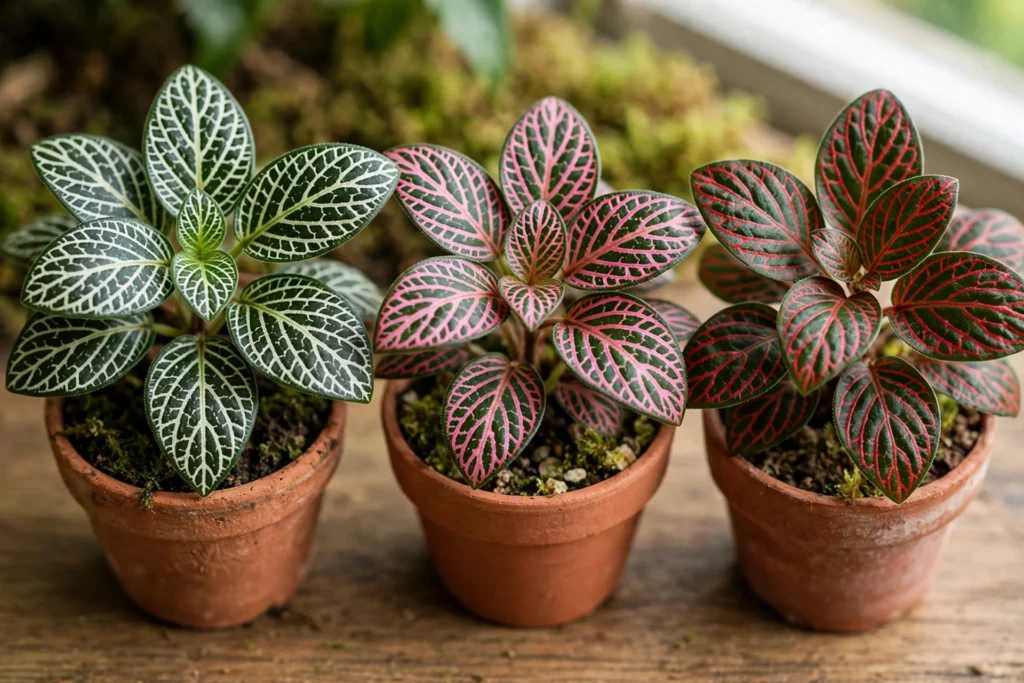
White Anne Fittonia
White anne fittonia is the classic white-veined type. Its dark green leaves carry a bright white net, and it is often sold as the silver nerve plant or white nerve plant. It is the most common variety in stores and a good first pick.
Pink Nerve Plant
A pink nerve plant has soft pink veins instead of white. The best-known pink type is the nerve plant Pink Angel, with gentle pink lines on green leaves. Pink nerve plant care is the same as for the white types, but pink veins can fade a little in low light, so give it a bright spot.
Ruby Red Fittonia
Ruby red fittonia, also sold as the red nerve plant or red vein nerve plant, has deep red veins that look almost crimson. Fittonia ruby red types include ‘Ruby Red’ and the smaller ‘Mini Red Vein’. A red fittonia plant makes a strong accent next to white-veined types.
More Types Worth Knowing
The fittonia family has a few more faces. Primetime fittonia is a compact white-veined cultivar for small pots. Fittonia white nerve plant types with silvery leaves are often labeled ‘Silvernet’ or ‘White Star’. Pink veined nerve plant types with a purple cast are sold as purple nerve plant, and fittonia nerve plant pink forms with fine lines are sometimes called ‘Pink Vein’. Fittonia nerve plant red forms with bold red veins are the showiest of all. Whatever the label says, check the veins: bright, crisp lines mean a healthy plant.
Light: Bright and Indirect
Nerve plant light requirements are simple: bright, indirect light. An east-facing window is ideal, because the morning sun is soft. A spot a few feet back from a south or west window works too, as long as sheer curtains filter the sun. A north window can work if the room is bright, but growth will be slow.
Do nerve plants need a lot of light? They need more than a dark corner, but less than a sunny sill. Direct sun is the real enemy. It scorches the thin leaves, bleaches the veins, and can make leaves drop. Do nerve plants like sun? Only filtered sun. If the leaf color fades or the veins turn dull, the plant is probably getting too much light or too little. Move it a little farther from the window and watch for a week.
How much light does a nerve plant need each day? Aim for a bright room where you could read a book all day without a lamp. If the plant grows leggy, with long stems and wide gaps between leaves, it needs more light. Rotate the pot a quarter turn each week so it grows evenly.
Watering: Even Moisture, Never Soggy
Watering is where most nerve plant trouble starts. The goal is evenly moist soil, never dry and never soggy. How often to water a nerve plant depends on light, heat, and pot size, but a good rhythm is every 3 to 5 days in spring and summer, and about once a week in winter when growth slows.
When to water a nerve plant? Check the soil, not the calendar. When the top half inch feels dry, water. How to water a nerve plant the right way: pour room-temperature water slowly until it runs out of the drainage holes, then empty the saucer. Never let the pot sit in standing water. How often should I water my nerve plant if the air is dry? More often, but still by the finger test. In a warm, bright room the soil dries faster; in a cool, dim room it stays wet longer.
Use filtered water or rainwater if your tap water is hard. Fluoride and salts in tap water can brown the leaf edges over time. Switching to filtered water usually stops new brown tips within a month.
The famous faint is part of watering too. When the soil dries out, the whole plant collapses flat within hours. It looks dead, but it is not. Water it well and it usually stands back up in 30 to 60 minutes. Do not let it faint often, though. Each faint stresses the plant, and repeated droughts cause leaf drop and crispy edges that do not heal.
Best Soil for a Nerve Plant
The best soil for a nerve plant holds moisture yet drains well. Nerve plant soil should be rich and loose, not heavy. A good mix is 2 parts peat-based or coco coir potting mix, 1 part perlite, and a handful of fine orchid bark. African violet mix also works well, because it is light and holds moisture without staying wet.
Always use a pot with drainage holes. Nerve plants have shallow roots, so a low, wide pot suits them better than a deep one. A pot 4 to 6 inches across is right for a store-bought plant. When you pot it up, set it at the same depth it grew before, press the mix gently to remove air pockets, and water it in well.
Temperature and Humidity
A nerve plant is a true tropical plant. Keep it between 65 and 80 degrees Fahrenheit during the day, and never let it drop below 60. Cold drafts from a door or window can make leaves drop overnight, so keep it away from drafty spots and heating vents.
Do nerve plants like humidity? They love it. Humidity is the single biggest factor in fittonia care. Aim for above 50 percent, and 60 to 70 percent is better. Most heated or air-conditioned homes sit at 30 to 40 percent, which is too dry. That is why the leaf edges turn brown even when the watering is right.
Do nerve plants like to be misted? Misting gives a short boost, but the effect fades in minutes. It helps a little, yet it is not a real fix for dry air. Better options are a pebble tray with water under the pot, grouping the plant with other humidity lovers, running a small humidifier nearby, or growing it in a terrarium. A terrarium is the most reliable fix of all, and the plant loves it there.
Is a nerve plant indoor or outdoor? In most of the United States it is an indoor nerve plant only. It can live outside year-round only in USDA zones 11 to 12. In summer you can set it on a shaded porch when nights stay above 65 degrees, but bring it in before the first cool night, and never put it in direct sun.
Feeding Your Fittonia
Fittonia care includes light feeding in the growing season. Give a balanced liquid houseplant fertilizer at half strength once a month from spring through summer. Do not feed in fall and winter, when growth slows. Too much fertilizer burns the leaf tips, so half strength is enough. If white crust appears on the soil, flush the pot with plain water and skip the next feeding.
Growing a Nerve Plant in a Terrarium
A nerve plant terrarium is the easiest way to keep this plant happy. A closed or open glass terrarium holds humidity around the leaves, which is exactly what the plant wants. Terrarium for nerve plant setups suit small varieties best, because the plant stays low and spreads sideways.
To plant one, use a glass container with a drainage layer of pebbles, then a thin layer of charcoal, then moist potting mix. Set the plant in, water lightly, and place it in bright, indirect light. Open a closed terrarium for a few minutes each week to let fresh air in, and trim the plant when it touches the glass. A nerve plant in a terrarium rarely needs misting, and its veins stay bright for months.
How to Propagate a Nerve Plant
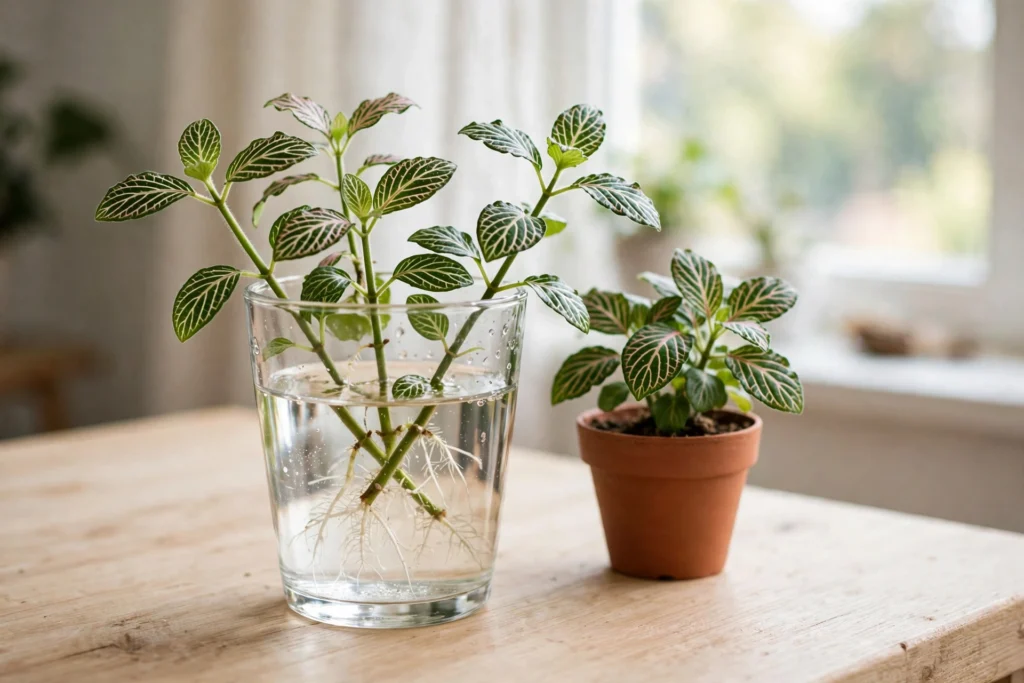
Fittonia propagation is easy, and a stem cutting is all you need. Propagate nerve plant cuttings in spring or early summer, when the plant grows fastest.
Where to cut a nerve plant for propagation? Pick a healthy stem 3 to 4 inches long with at least 2 or 3 nodes. A node is the small bump where a leaf joins the stem, and roots grow from there. Cut just below a node with clean scissors. Remove the lower leaves so no leaf sits under water or in soil.
Can you propagate a nerve plant in water? Yes, and it is the simplest way. How to propagate nerve plant in water: stand the cutting in a glass of room-temperature water, keep the leaves above the surface, and set the glass in bright, indirect light. Change the water every few days. Roots usually appear in 2 to 3 weeks. Can nerve plants live in water forever? No. Move the cutting to moist potting mix once the roots are about an inch long, or the stem will rot.
You can also propagate nerve plant cuttings straight into soil. Dip the cut end in rooting hormone if you have it, push it into moist mix, and cover the pot with a clear plastic bag to hold humidity. New growth in 3 to 4 weeks means it took. Division works too: when you repot a large plant, gently pull the root ball into two or three pieces, each with stems and roots, and pot each piece separately.
Pruning and Repotting
Pruning keeps a nerve plant bushy. How to make a nerve plant bushier? Pinch back the stem tips every few weeks during the growing season. Each pinch makes the plant branch below the cut, so the plant fills out instead of growing leggy. How to prune a nerve plant is simple: snip just above a leaf node with clean scissors, and use the cuttings to propagate new plants.
When to repot a nerve plant? Every 1 to 2 years in spring, or when roots circle the pot or poke out of the drainage holes. Do nerve plants like to be root bound? They tolerate a snug pot, but a badly root-bound plant dries out too fast and stops growing. How to repot nerve plant: choose a pot one size larger, fill it with fresh mix, set the plant at the same depth, and water it in. Trim any black or mushy roots while you have it out of the pot.
Nerve Plant Flowers
Do nerve plants flower? Yes, but the flowers are not the point. A nerve plant flower is a small, pale spike that appears in summer on a mature plant. Nerve plant flowering takes energy away from the leaves, and most growers snip the flower spikes off as soon as they appear so the plant keeps making leaves. If you want to see them once, let one spike open, then pinch it off. Flowering is not a sign of trouble, and it does not mean the plant is dying.
Common Problems and Fixes
Most nerve plant problems come from water, light, or humidity. The plant shows the cause on its leaves, so read the symptoms below before changing everything at once.
Leaves Curling
Why are my nerve plant leaves curling? Curling is usually low humidity or dry soil. Nerve plant leaves curling inward means the leaves are losing water faster than the roots can replace it. Raise the humidity, check that the soil is moist, and move the plant away from heat vents. The leaves often uncurl within a day.
Crispy Brown Edges
Why are my nerve plant leaves crispy? Brown, papery edges mean dry air, salts in the water, or inconsistent watering. Nerve plant leaves crispy at the tips rarely heal, so trim the brown edge with clean scissors and fix the cause: raise humidity, switch to filtered water, and keep the soil evenly moist.
Sudden Wilting
A nerve plant that faints flat is almost always thirsty. Water it well and wait an hour. Are nerve plants dramatic? Yes, famously so. The faint looks like death, but it is a water-pressure trick, not damage. If the plant does not perk up after watering, check the roots for rot.
Leggy Growth
Long, bare stems with small leaves mean too little light. Move the plant to a brighter spot and pinch back the leggy stems. The cuttings root easily, so nothing is wasted.
Yellow Leaves and Root Rot
Yellow, limp leaves usually mean overwatering. Nerve plant root rot starts in soggy, airless soil. If the stems feel soft at the base, take the plant out, cut away black mushy roots, and repot in fresh, dry mix. Water less after that, and always empty the saucer.
Pests
Aphids, thrips, spider mites, and mealybugs show up on stressed fittonia, especially in dry air. Check the undersides of leaves each week. A strong spray of water removes aphids, and neem oil or insecticidal soap handles the rest. Isolate the plant while you treat it so pests do not spread. The mosaic virus is rarer and has no cure: blotchy yellow mottling and twisted leaves mean the plant should be thrown away, and your scissors should be cleaned before you touch another plant.
Pet Safety: Cats, Dogs, and Kids
Is a nerve plant toxic to cats? No. Are nerve plants toxic to cats, dogs, or people? No to all three. Nerve plants are non-toxic to cats and dogs, and safe around children. New owners often search for nerve plant toxic to cats because they want to be sure, and the answer is reassuring: fittonia is one of the safest houseplants for a home with pets.
Even if a curious cat chews a leaf, the plant is not poisonous, so a nerve plant is cat safe in every sense. The cat may still damage the plant, so a hanging basket or a high shelf keeps both the cat and the plant happy. Like spider plants, nerve plants are a safe pick for pet homes, and our spider plant care guide covers another pet-safe favorite.
Buying, Size, and Growth
How big do nerve plants get? A nerve plant full grown indoors is about 3 to 6 inches tall and 6 to 12 inches wide. It is a slow, steady grower, not a plant that takes over a room. How fast do nerve plants grow? Moderately fast in spring and summer, slow in winter. A young plant fills a 4-inch pot in one season and needs a bigger pot in a year or two.
How long do nerve plants live? With good care, several years. The plant does not die after flowering, and a leggy old plant can be renewed by pruning it back hard in spring and rooting the cuttings.
Where to buy a nerve plant? Garden centers, nurseries, and online plant shops all carry them, usually for a few dollars in a 4-inch pot. Where can I buy a nerve plant if stores are out? Online sellers ship year-round, but avoid ordering in freezing weather. A local shop is the best choice, because you can check the leaves before you buy: look for bright veins, firm leaves, and no brown edges or pests. Pilea peperomioides is another small, friendly houseplant that often sits on the same nursery shelf, and our pilea peperomioides guide covers it in the same detail.
Quick Care Recap
A nerve plant asks for three things: steady moisture, bright indirect light, and humid air. Water when the top half inch dries out, feed lightly in spring and summer, pinch the tips to keep it bushy, and grow it in a terrarium if your home air is dry. When it faints, do not panic. Water it, wait an hour, and it will stand up again. That is the whole secret.
If this guide helped, you may also like our bird of paradise plant care guide, another tropical plant that loves bright light and humidity. For a fuller look at the science behind fittonia care, Epic Gardening’s nerve plant guide covers planting, feeding, and troubleshooting in depth.
Are nerve plants toxic to cats?
No. Nerve plants (Fittonia albivenis) are non-toxic to cats, dogs, and people, so they are a safe pick for pet homes.
Why are my nerve plant leaves curling?
Curling usually means low humidity or dry soil. Raise the humidity, keep the soil evenly moist, and move the plant away from heat vents; leaves often uncurl within a day.
How often should I water a nerve plant?
Every 3 to 5 days in spring and summer, about once a week in winter. Water when the top half inch of soil feels dry, and never let the pot sit in standing water.